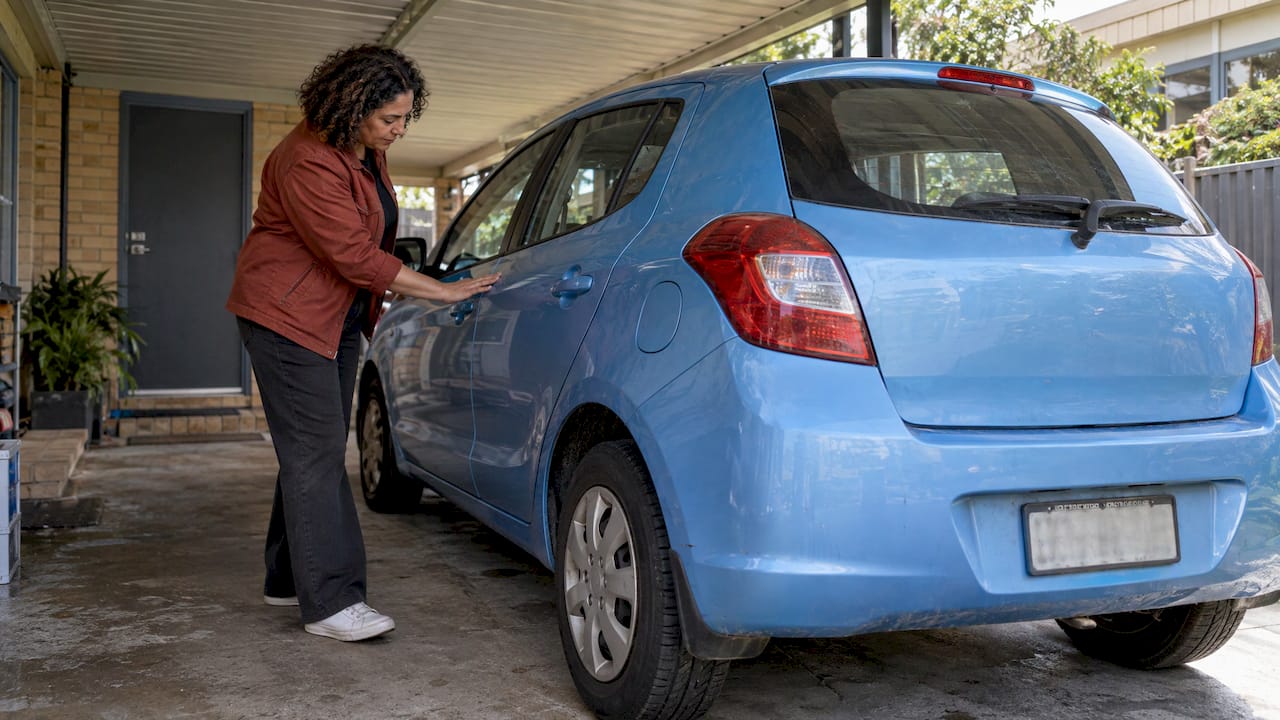
A secured car loan is a loan where the car you are buying is the security. If repayments stop, the lender has the right to repossess and sell the car to recover what is owed. That one feature shapes the vehicle rules, the fees, the insurance you need and the risks, so it pays to understand it before you sign anything. At AFH Finance we are a broker, not a lender: a real broker compares a panel of 40+ lenders for employed Australians and ABN holders, and the options that may suit you depend on your situation, the car and the lender’s own criteria.
See your options from our panel of 40+ lenders
Soft enquiry, no credit score impact. No cost to check your options.
Compare my optionsThis guide is general information only, not personal advice. For your own circumstances, talk to a broker.
AFH Finance
afhfinance.com.au
Compare Finance for Your Car
AFH Finance compares car loan options from a panel of 40+ lenders, with a soft enquiry that has no credit score impact.
TL;DR
- A secured car loan uses the car as security, so the lender can repossess and sell it if you fall seriously behind on repayments.
- Rates are set by the lender based on your situation, the car and the loan. Secured loans usually carry a lower rate than unsecured ones, according to Moneysmart.
- Lenders set rules on car age, loan size and private sale purchases, so the car you want affects which lenders may suit you.
- Read the whole fee picture: establishment fees, any broker fee, monthly fees and default charges, plus the comprehensive insurance a secured loan usually needs.
- Checking your options with AFH Finance is a soft enquiry, no credit score impact. No cost to check your options.
Table of Contents
- What a secured car loan actually is
- Secured and unsecured car finance compared
- What lenders look at: the car and the borrower
- New, used and private sale cars
- The fees to read before you sign
- Insurance on a secured car
- What happens if you fall behind
- How to compare secured car finance step by step
- Compare secured car finance with AFH Finance
- Our view on secured car finance
- FAQ
- Sources
What a secured car loan actually is
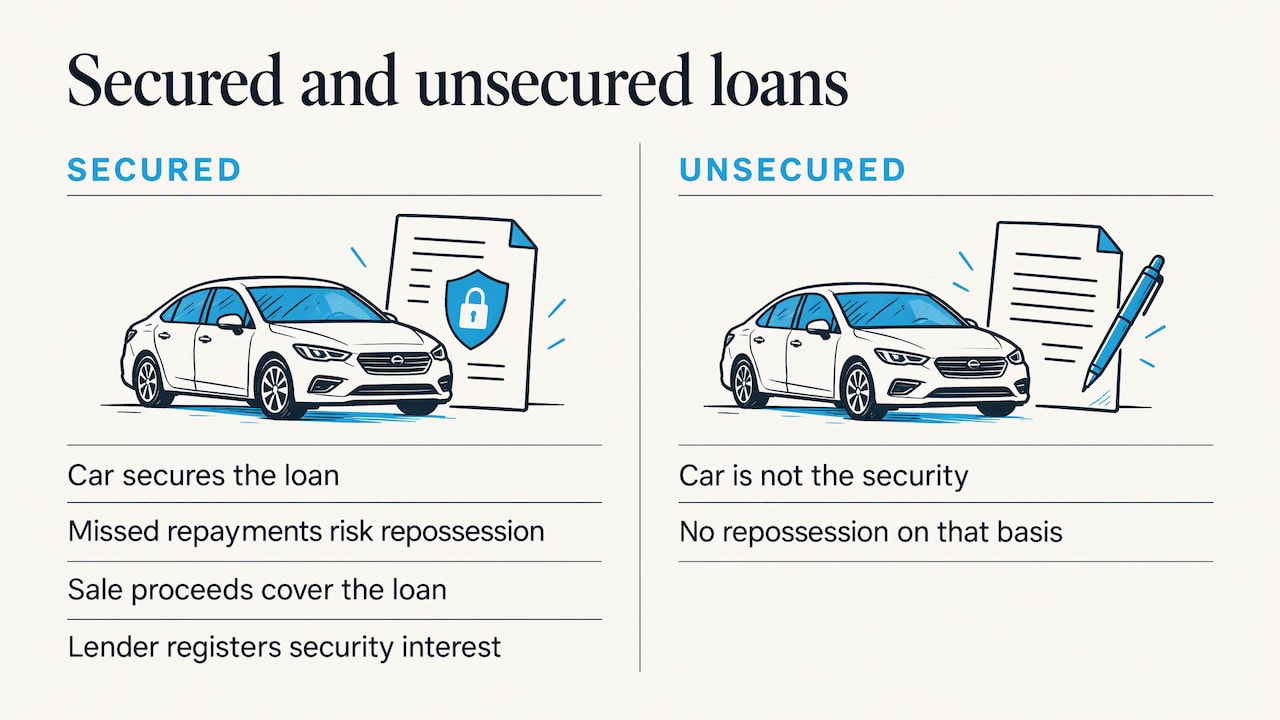
When you take out a secured car loan, the lender registers an interest in the vehicle. Moneysmart explains that with a secured loan, if you do not meet your repayments the lender can take your vehicle and sell it to cover the loan. With an unsecured loan the car is not the security, so the lender cannot seek to repossess and sell it on that basis.
The lender also records its interest publicly. The government’s Personal Property Securities Register explains that when a car is used as security, the lender registers its security interest, and that right to repossess can remain even after the car has been sold on to someone else. In practice, this is why a buyer of a used car from a private seller should check the car is not already security for someone else’s loan.
A car loan is, in legal terms, a personal loan for buying a new or used car. ASIC’s car loans factsheet notes that terms are usually somewhere between 12 months and 5 years. The loan sits against the car for the whole term, and the lender’s security usually ends when the loan is repaid in full.
Secured and unsecured car finance compared
The core differences come down to what you put on the line and what the lender can do about it.
Secured loans
With a secured loan you offer an asset, here the car, as security. According to the ASIC and Moneysmart factsheet, if you do not make repayments the credit provider can repossess and sell the car without going to court, and you usually pay a lower interest rate than on an unsecured loan. The exact rate is set by the lender based on your situation, so two borrowers can be offered different terms on the same car.
Unsecured loans
With an unsecured loan you do not offer an asset as security. The same factsheet explains that the credit provider can still take you to court to recover the money, and that interest rates are usually higher. Unsecured loans are a personal loan product more broadly, and we cover how they work in our guide to unsecured personal loans in Australia.
Why the difference matters when you shop
Because the lender has the car to fall back on, secured loans are generally more widely available for vehicles that hold their value. The ASIC factsheet notes secured loans are usually only available for newer cars because they are more valuable as an asset. That is a useful rule of thumb, but lender policies vary, which is where comparing across a panel helps.
What lenders look at: the car and the borrower
Two things drive a secured car loan: the vehicle and you.
The vehicle
In June 2026 ASIC published Report 832, a review of car finance. Among the lenders it reviewed, most secured car loans offered terms between 12 and 84 months, with some setting a minimum term of 24 months. Minimum loan amounts sat around $5,000, and maximum loan amounts across lenders ranged from $55,000 to $300,000. Most lenders limited loans to cars no older than 15 years at the end of the loan term.
The same report notes that only some lenders financed private sales, and a limited number financed grey imports, repairable write offs, or cars up to 25 years old at maturity. If you are looking at an older car, a private sale or an unusual import, the choice of lenders narrows, so it is worth knowing early which ones can consider it.
A car’s age at the end of the term matters as much as its age today. A five year old car on a five year loan is a ten year old car at maturity, which can sit well inside many lenders’ limits. A twelve year old car on the same term would be seventeen at maturity, which would fall outside the limit most lenders apply.
The borrower
Our service is built for employed Australians and ABN holders. Lenders typically look at your income and employment, your expenses, your existing commitments and your credit file. Because each lender weighs these differently, the options that may suit you can differ from lender to lender. That is the reason to compare across a wider panel rather than apply one lender at a time.
New, used and private sale cars
Secured finance covers all three, and each has its own wrinkles.
- New cars: from a dealer, usually the simplest to finance because the car is young and its value is clear. See our guide to new car finance in Australia for what to check.
- Used cars: more variation between lenders on age and kilometres. Our guide to used car finance in Australia covers how it works and how to apply.
- Private sale: you buy from an individual rather than a dealer, and the seller is not part of the finance. Because the seller can have a loan registered against the car, checking the car’s status on the PPSR matters. If you want a method for checking a used vehicle before you commit, this guide on securing a used car purchase walks through one.
We arrange car finance for new, used and private sale cars, utes and SUVs, from dealers or private sellers.
The fees to read before you sign
A rate is only part of what a loan costs. Moneysmart lists the common car loan fees: an establishment fee charged once, a broker fee that must be disclosed on the finance contract, a dealership or introducer fee, and other charges such as a monthly service fee, a default or missed payment fee, and default interest.
ASIC’s Report 832 gives a sense of scale. It found consumers generally pay two fees across the sector: a loan establishment fee, commonly $299 to $995, and a distributor establishment fee, commonly $912 to $1,500. It also found that when loan amounts are low, those fees often make up a substantial proportion of the overall loan. So the fee structure matters most on smaller loans.
When you compare options, ask for each of the following in writing:
- The establishment fee and any other upfront fee.
- Any broker fee, and whether it is added to the loan amount.
- Monthly account or service fees.
- Fees for missed repayments and the default interest that can apply.
- What happens if you want to repay early or sell the car.
At AFH Finance, our fees are explained in writing before you go ahead. We are paid by lenders, and a broker fee may be added to your loan. You can run numbers on our car loan and personal loan repayment calculator to see indicative repayments before you speak to a broker.
Insurance on a secured car
Because the lender has an interest in the car, they will usually want it protected. The ASIC factsheet says that if your car loan is secured you will usually need comprehensive insurance, and that it is often cheaper to arrange your own insurance than to go through the car dealership. Build the premium into your running costs from the start, because it is an ongoing cost alongside repayments.
What happens if you fall behind
This is the part of a secured loan to understand well, and it is why it is sensible to talk through your situation with a broker before you commit.
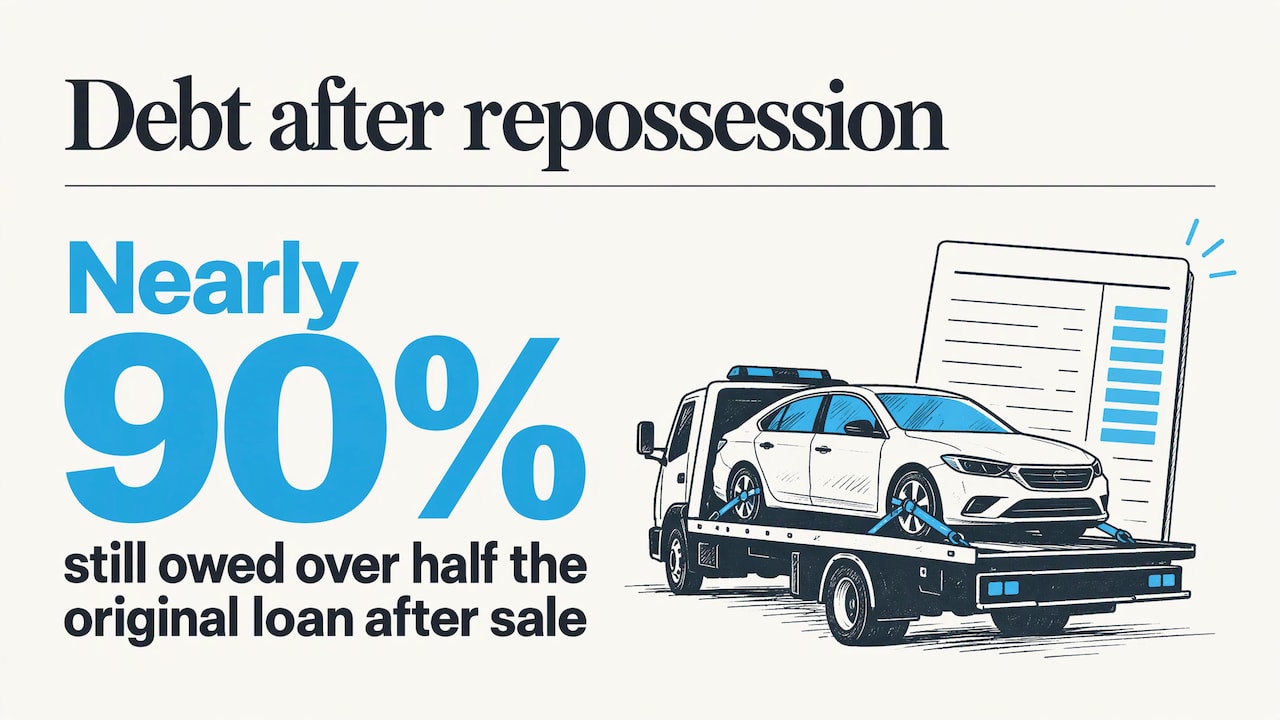
ASIC’s Report 832 notes that lenders usually apply a default or dishonour fee when a scheduled repayment is missed, and in some cases charge higher default interest while the balance is overdue. Its review of more than 250 repossessed loans found that in nearly 90% of cases the consumer still owed over half of the original loan amount after the car was repossessed and sold. In other words, losing the car does not necessarily clear the debt.
If you think you might struggle to make a repayment, contact your lender early. Lenders have hardship processes, and Moneysmart and the National Debt Helpline (1800 007 007) are good places to start for independent guidance.
If you want to sell the car before the loan ends, the lender’s security usually has to be dealt with first, because the lender’s interest stays registered against the car. Repaying a fixed rate loan early can also involve break costs, so check the terms before you decide.
How to compare secured car finance step by step
Australian regulators suggest sorting out your finance before you fall for a car. Moneysmart’s factsheet points out that getting a good credit deal is as important as the price of the car, and that arranging finance before you shop means you will only have one high pressure decision to make at the dealership.
- Work out your budget and running costs. Include insurance, registration, servicing and fuel, not just the repayment. Decisions about how much to borrow are yours to make, ideally after talking to a broker about your situation.
- Decide on the type of car. New, used or private sale, and its age at the end of the loan term, all affect which lenders may suit you.
- Compare options before you visit a dealer. Look at repayments, fees and the loan term together, not the repayment alone.
- Read the fee disclosure. Check establishment fees, broker fees, monthly fees and default charges, and keep a written copy.
- Confirm insurance. Plan for comprehensive cover from the day you take the car.
- Check the car. For a private sale, check the PPSR for existing security interests before you pay.
A broker can take on much of this work. At AFH Finance, you start online with a short set of questions and see indicative repayments. A real broker then calls you back to confirm the options that may suit your situation, and explains fees in writing before anything proceeds.
Compare secured car finance with AFH Finance
We are an Australia wide finance broker. A real broker, not a call centre, compares a panel of 40+ lenders for you. Checking your options is a soft enquiry, no credit score impact, and there is no cost to check your options. We are paid by lenders, and a broker fee may be added to your loan, always explained in writing before anything proceeds. Our clients include employed Australians and ABN holders buying new, used and private sale cars. We are rated 5.0 on Google from 63 reviews, with 750+ borrowers helped.
If you are ready to look at options, start with our car loans page. If you are weighing up a caravan, see caravan loans, or visit AFH Finance to see everything we arrange.
Our view on secured car finance
We think a secured car loan is one of the most practical ways to finance a vehicle, provided you go in with open eyes. The car is the security, which is why lenders can set rules on age and value, and why the options open to you depend so much on the car you choose.
What we see as the real difference is comparing across lenders. Each lender sets its own rate based on the borrower’s situation, its own vehicle limits and its own fees. Applying to one lender at a time means seeing one set of terms. A broker who compares a panel of 40+ lenders can show you more of the options that may suit you, in one conversation.
We also believe in being plain about fees. We are paid by lenders, and a broker fee may be added to your loan, so we explain fees in writing before anything proceeds. Checking your options is a soft enquiry, no credit score impact, and there is no cost to check your options.
If you are an employed Australian or an ABN holder, talk to a broker about your situation before you choose a car.
AFH Finance
FAQ
Is a secured car loan better than an unsecured one?
Neither suits everyone, and it depends on your situation and the car. Secured loans usually carry a lower interest rate because the lender holds the car as security, and unsecured loans do not require an asset as security. A broker can talk you through the options that may suit you.
Can I get a secured car loan for a private sale?
Yes, some lenders finance private sales, though not all of them do. ASIC’s 2026 review found that only some lenders in its sample provided private sale loans. We arrange finance for private sale cars, so ask a broker which lenders may suit your purchase.
Does the age of the car matter?
Yes. Many lenders limit loans to cars no older than 15 years at the end of the loan term, and a limited number consider cars up to 25 years old at maturity. Older cars usually have fewer lenders to choose from.
Do I need comprehensive insurance?
Usually, yes. ASIC’s factsheet says a secured car loan will usually require comprehensive insurance. You can often arrange your own cover rather than taking it through the dealership.
Does checking my options affect my credit score?
At AFH Finance, checking options is a soft enquiry, no credit score impact. A real broker then calls you to confirm the options that may suit you, and there is no cost to check your options.
Sources
- Car loans, Moneysmart
- Credit Factsheet: Car Loans, ASIC and Moneysmart
- Report 832, Lifting the bonnet: ASIC’s review of car finance
- Sarah’s unknown loan, Personal Property Securities Register
- Securing a used car purchase, Inspectoo
Recommended
- Used Car Finance in Australia: How It Works and How to Apply
- New Car Finance in Australia: How It Works and What to Check
- Car Loans Australia
See your options from our panel of 40+ lenders
Soft enquiry, no credit score impact. No cost to check your options.
Compare my optionsGeneral information only. This article doesn't consider your objectives, financial situation or needs, and isn't a credit offer. Lending criteria, fees and charges apply. We're paid by lenders, and a broker fee may be added to your loan. AFH Finance Pty Ltd, Credit Representative 548852 of Access Lending Group Pty Ltd, ACL 531308.