Used car finance is a loan that lets you buy a second hand car, ute or SUV now and repay it, with interest and fees, over a set term. In Australia that is usually between one and seven years, according to Moneysmart. The loan can be arranged through a dealer, a bank, a credit union or a broker, and you can sort it out before you ever step onto a car yard. This guide explains the loan types, the costs that sit behind the repayment, what lenders look at, how private sales differ and what to have ready.
See your options from our panel of 40+ lenders
Soft enquiry, no credit score impact. No cost to check your options.
Compare my optionsAFH Finance
Compare finance for your used car
AFH Finance helps you compare used car loan options from a panel of 40+ lenders, with no credit score impact when checking options.
TL;DR
- A used car loan is repaid with interest over a fixed term, often one to seven years, and can be secured against the car or unsecured.
- The repayment is only part of the cost. Establishment, broker, dealership and monthly fees, plus any balloon payment, all change what you pay in total.
- Lenders assess your income, bills and existing commitments. Rates are set by the lender based on your situation.
- Buying private sale? Check the car for money owing before you pay, and make your purchase conditional on finance.
- AFH Finance is a broker. No cost to check your options. Soft enquiry, no credit score impact.
Table of Contents
- How a used car loan works
- Secured and unsecured used car loans
- What used car finance really costs
- What lenders look at
- Documents and details to have ready
- Buying from a dealer or by private sale
- Why use a broker for a used car loan
- Talk to a broker about your used car
- A simple plan for financing a used car
- FAQ
- Sources
How a used car loan works
You borrow a lump sum, the lender pays the seller, and you repay the lender in regular instalments. Each repayment covers some of the amount borrowed plus interest and any fees. At the end of the term the loan is finished and the car is yours outright.
Moneysmart describes a car loan as a personal loan used to buy a car, repaid with interest over a fixed term. That is true of used cars as much as new ones. What changes with a used car is mostly the details around it: the age and condition of the vehicle, who you are buying from and how the lender views the car as an asset.
Consumer Protection Western Australia notes that the age of the car may affect the finance options available to you. So if you are looking at an older vehicle, it is worth raising that early rather than after you have fallen for a particular car.
Secured and unsecured used car loans
Most people will hear two terms when they start comparing: secured and unsecured.
| Secured loan | Unsecured loan | |
|---|---|---|
| What backs the loan | The car itself | Nothing: the car is not security |
| If repayments are missed | The lender can take and sell the vehicle | The lender can pursue the debt by other means |
| Interest rate | Set by the lender based on your situation | Often higher, according to Moneysmart |
The first two rows of detail come from Moneysmart’s car loan page: with a secured loan the lender can take and sell the car if you do not keep up repayments, while an unsecured loan does not use the car as security and the interest rate is often higher. Which structure suits you depends on your situation, the vehicle and what the lender offers. A broker can explain how different lenders on their panel treat each.
Dealer finance, a regular car loan or a novated lease
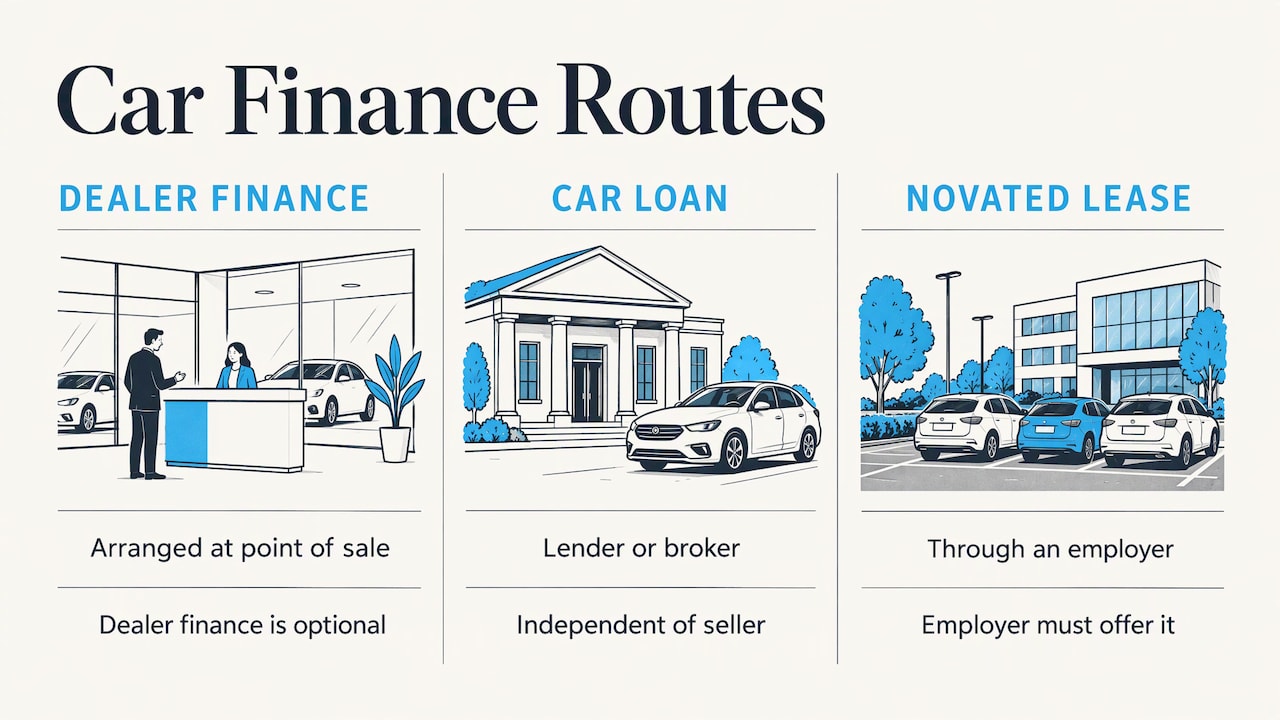
Consumer Protection WA lists three common routes: dealer finance, a regular car loan and a novated lease. Dealer finance is arranged at the point of sale. A regular car loan is arranged with a lender or through a broker, independent of the seller. A novated lease is an arrangement through an employer, so it only applies if you are an employee whose employer offers it.
You are not locked into whichever is offered first. Both Legal Aid Queensland and NSW Fair Trading point out that buyers do not have to accept finance arranged by a dealer. Arranging your own finance before you shop also lets you focus on the car and the price, rather than negotiating both at once.
What used car finance really costs
The advertised repayment is the number most people focus on. The total you pay is made up of more.
Moneysmart says the cost of a car loan can include interest, establishment fees, broker fees, dealership or introducer fees, as well as ongoing charges such as monthly service fees and default or missed payment fees. Here is how to think about each:
- Interest. Set by the lender based on your situation, the loan structure and the vehicle. It is the largest part of the cost over a long term.
- Establishment fees. A one off charge to set the loan up.
- Monthly service fees. A recurring charge that adds to the total over the life of the loan.
- Broker, dealership or introducer fees. Paid to whoever arranged or introduced the loan. Ask for these in writing.
- Default and missed payment fees. Avoidable, but worth knowing before you sign.
The loan term
A longer term lowers each repayment but means interest is charged for more months. A shorter term raises each repayment and shortens the period you are paying interest. Neither is automatically right. What matters is that the repayment fits your budget with room to spare, and that you understand the total over the whole term.
Balloon payments
A balloon is a final lump sum due at the end of the loan, in exchange for lower regular repayments. Moneysmart explains that the total cost is generally higher with a balloon because the lump sum also attracts interest. If you are considering one, ask how you would plan to pay it when the time comes.
What to check before you sign
Consumer Affairs Victoria advises buyers to check every fee and interest rate, the repayment amount and due dates, the total paid over the loan and the insurance requirements before signing. It also says the National Credit Code applies to most consumer finance, so providers must put rates, fees and commission in a written contract. Read that contract, not just the summary.
A sensible habit is to use a repayment calculator first so the numbers are in front of you. Our car loan and personal loan repayment calculator shows indicative repayments. Rates are set by the lender based on your situation, so the final figures can differ.
What lenders look at
When you apply, the lender is working out whether the repayments suit your finances. Moneysmart says lenders examine your income, bills and commitments, and that they must not lend where they believe you could not make repayments without financial difficulty.
In practice, expect lenders to consider:
- Your income and how stable it is, whether you are employed full time, part time or an ABN holder.
- Your regular expenses and living costs.
- Existing loans, credit cards and other commitments.
- Your credit history, including how you have handled past repayments.
- The car: its age, type and value, and whether you buy from a dealer or by private sale.
Moneysmart also lists things that can contribute to a loan being declined: late or missed repayments, unpaid debts, many recent applications, defaults and serious credit infringements. That last point about many recent applications is worth remembering. Applying to lender after lender on your own can leave a trail on your credit file. Checking options through a broker with a soft enquiry, no credit score impact, is a gentler way to start.
Steps that put you in a stronger position
Moneysmart suggests several practical steps if you want to strengthen an application: check your credit report and correct any errors, reduce debts, create a budget, wait before applying again and choose a loan amount that fits your income and expenses. We would add one thing as general information only: the amount you borrow is your decision, ideally made with your budget in front of you and a conversation with a broker about your own situation.
Documents and details to have ready
Lenders vary in what they ask for, and your broker will confirm the list for your situation. Most applications involve some combination of the following.
About you
- Photo ID, such as a driver licence.
- Proof of income. For employees that is usually recent payslips and sometimes bank statements. ABN holders are often asked for tax returns, notices of assessment or business bank statements.
- Details of your living situation, employment and existing debts.
About the car
- Make, model, year and kilometres.
- The VIN or chassis number and the registration details.
- The seller’s details and the price, often shown on a dealer’s sales contract or a private seller’s invoice.
Having these to hand means the conversation with your broker can focus on the options that may suit you, not on hunting for paperwork.
Buying from a dealer or by private sale
The loan itself works the same way. The risk around the purchase does not.
NSW Fair Trading explains that licensed dealers must ensure no money is owing on the vehicle, while private buyers must check for themselves and have less consumer protection. Private buyers should also verify ownership and make sure the paperwork matches the car.
Checking a private sale car
The Personal Property Securities Register is the place to check. A PPSR vehicle search shows whether a security interest is recorded against the car, and it may also show if the car is recorded as stolen or written off. The online search costs $2.00 and you need the car’s VIN or chassis number, not the number plate.
For a private sale, a short checklist helps:
- Ask the seller for the VIN and run a PPSR search before you hand over any money.
- Confirm the seller’s name matches the registration and ownership paperwork.
- Check the VIN on the car matches the documents.
- Talk to your broker about how the lender will pay a private seller, so settlement is organised before you commit.
Our car loans cover new, used and private sale cars, utes and SUVs bought from dealers or private sellers.
Make the purchase conditional on finance
Consumer Affairs Victoria advises making the sale contract conditional on finance, and Legal Aid Queensland says the same where finance is needed. That way you are not committed to buy a car if the loan does not come through. Legal Aid Queensland also says you should arrange comprehensive insurance, and many lenders will require it on a financed car.
Why use a broker for a used car loan
You can shop banks, credit unions and other providers yourself, as Consumer Affairs Victoria suggests. The catch is time and repeated applications. A broker is a middle step: one conversation, with a panel of lenders behind it.
Our view: a real broker, not a call centre
We see the same pattern with used car buyers. They find a car they like, then discover finance is a maze of lenders, fees and terms they have never had to compare. We built AFH Finance so you can start online with a short set of questions, see indicative repayments, then talk to a real broker who looks across our panel of 40+ lenders for options that may suit your situation.
We are a broker, not a lender. Rates are set by the lender based on your situation, so we do not pretend to know the number before the lender does. What we do is explain the options and the fees in writing before anything proceeds. We are paid by lenders, and a broker fee may be added to the loan. We tell you that up front, because you should know how we are paid.
We work Australia wide, for employed Australians and ABN holders. Checking your options is a soft enquiry, no credit score impact. We are rated 5.0 on Google from 63 reviews, and we have helped 750+ borrowers. For any decision about borrowing, a conversation with a broker about your own circumstances beats a general article every time, including this one.
AFH Finance
Talk to a broker about your used car
If you are comparing used car finance, we can help you see options from our panel of 40+ lenders for dealer and private sale cars. You answer a few questions online, see indicative repayments, and a broker calls you back to confirm the options that may suit your situation. There is no cost to check your options. We are paid by lenders, and a broker fee may be added to the loan, which we explain in writing before anything proceeds.
Start with our car loan broker page. Soft enquiry, no credit score impact. If you are buying for work as an ABN holder, our business loans and equipment finance page covers vehicles and equipment, and if you are planning a caravan, see our caravan loans.
This article is general information only and is not personal advice. Talk to a broker about your situation.
A simple plan for financing a used car
- Set your budget first. Look at your income, bills and commitments the way a lender will.
- Check your credit report and correct any errors before you apply.
- Decide how you will buy. Dealer or private sale changes the checks you need.
- Compare options, not just repayments. Look at fees, term, balloon and total cost over the loan.
- Make the purchase conditional on finance where you can.
- Run a PPSR search on any private sale car, using the VIN.
- Read the written contract and insurance requirements before you sign.
FAQ
Can I get used car finance if I am an ABN holder?
Yes, ABN holders can apply for used car finance. Lenders will usually want evidence of income, such as tax returns or business bank statements, instead of payslips. A broker can explain which documents suit your situation and which lenders on the panel may suit you.
Does checking my options affect my credit score?
At AFH Finance, checking your options is a soft enquiry, no credit score impact. Moneysmart notes that many recent applications can contribute to a loan being declined, so it helps to compare options before you formally apply anywhere.
Is it cheaper to buy a used car with a loan from a dealer?
Not necessarily. Dealer finance is one option, but buyers do not have to accept it, as NSW Fair Trading says. Compare fees, term and total cost over the loan, and ask for everything in writing.
Can I finance a private sale car?
Yes. We arrange finance for private sale cars as well as dealer purchases. Because private buyers have less consumer protection, run a PPSR search first and have the seller’s details and the car’s VIN ready.
How much does AFH Finance cost?
There is no cost to check your options. AFH is paid by lenders, and a broker fee may be added to the loan. We always explain it in writing before anything proceeds.
Sources
- Car loans, Moneysmart
- Loan rejection, Moneysmart
- Buying your first car, Consumer Protection Western Australia
- Used car loans and finance, Consumer Affairs Victoria
- Buying a car, Legal Aid Queensland
- Where to buy a vehicle, NSW Government
- Do a used car or vehicle search, PPSR
Recommended
See your options from our panel of 40+ lenders
Soft enquiry, no credit score impact. No cost to check your options.
Compare my optionsGeneral information only. This article doesn't consider your objectives, financial situation or needs, and isn't a credit offer. Lending criteria, fees and charges apply. We're paid by lenders, and a broker fee may be added to your loan. AFH Finance Pty Ltd, Credit Representative 548852 of Access Lending Group Pty Ltd, ACL 531308.