
An unsecured personal loan is a loan where you don’t put up an asset, such as your car or home, as security. The lender decides based on your income, expenses, debts and credit history instead. Because the lender carries more risk, rates are usually higher than on a secured loan, and each lender sets its rate based on your situation. This guide explains how these loans work, what they cost, what lenders look at and how to compare options. It is general information only, not personal advice.
See your options from our panel of 40+ lenders
Soft enquiry, no credit score impact. No cost to check your options.
Compare my optionsAFH Finance
Compare Personal Loan Options
AFH Finance compares personal loan options from a panel of 40+ lenders, with a soft enquiry that has no credit score impact.
TL;DR
- An unsecured personal loan has no asset attached as security, which is why people also search for a personal loan without collateral.
- Lenders usually charge higher interest on unsecured loans than secured ones, and rates are set by the lender based on your situation.
- Look at the whole cost: fees, loan term and the comparison rate, not only the headline interest rate.
- Missing repayments can mean fees, default interest and, in the end, legal action to recover the money.
- At AFH Finance, a broker compares options from our panel of 40+ lenders. No cost to check your options. Soft enquiry, no credit score impact.
Table of Contents
- What is an unsecured personal loan?
- Secured and unsecured loans side by side
- What you can use an unsecured personal loan for
- Who may qualify, and what lenders ask for
- What an unsecured personal loan costs
- How much would a $20,000 loan cost per month?
- What happens if you miss repayments
- Our perspective on unsecured personal loans
- See your options with AFH Finance
- A simple way to compare options
- FAQ
- Sources
What is an unsecured personal loan?
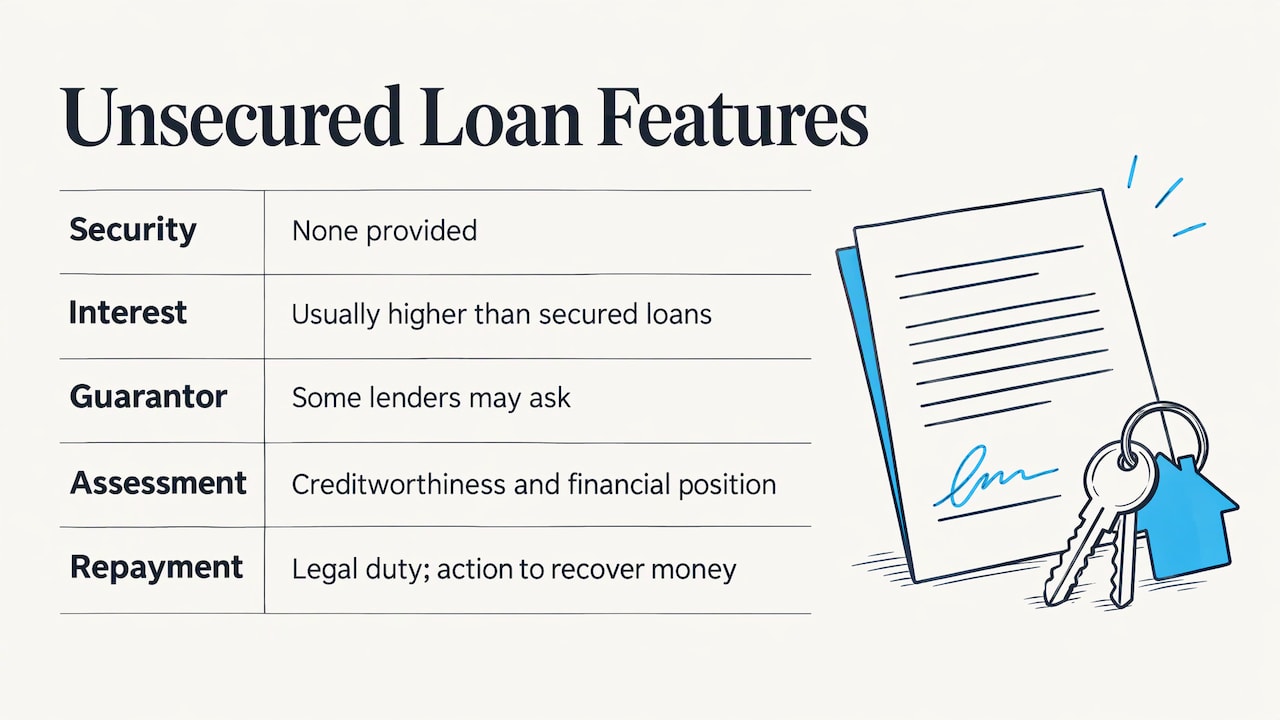
With an unsecured loan you don’t provide security. Moneysmart explains that these loans usually carry higher interest rates than secured loans, and some lenders may ask for a guarantor, someone who agrees to cover the loan if you can’t.
The phrase “without collateral” means the same thing. Collateral is the asset a lender could take if you stopped paying. On an unsecured loan nothing is named in the contract, so the lender relies on your creditworthiness and financial position. The Moneysmart credit factsheet on personal loans says you need to convince the credit provider that both are good enough.
“Unsecured” does not mean “no consequences”. You still have a legal obligation to repay. If you don’t, Moneysmart notes that the lender can take legal action to recover the money.
Secured and unsecured loans side by side
The main difference is what the lender can reach if things go wrong, and what that does to pricing and availability.
| Secured personal loan | Unsecured personal loan | |
|---|---|---|
| Asset as security | Yes, for example a car | No |
| If you stop repaying | The lender can take and sell the asset | The lender can take legal action to recover the money |
| Interest rate | Usually lower | Usually higher |
| Who can get one | Often easier, because the lender has security | Can be harder to get, because the lender carries more risk |
| Typical use | Buying a vehicle or other asset | Planned purchases, renovations, travel, weddings |
The security point is set out in the Moneysmart credit factsheet. On the court process, Legal Aid WA says that if you default on an unsecured loan, the credit provider needs a court order before it can take steps to take and sell assets you own. It also notes that because unsecured loans carry more risk for lenders, they can be harder to get and may cost more in interest.
A secured loan is not automatically the better choice, and an unsecured loan is not automatically the worse one. Some people prefer not to tie an asset to a loan. Others are happy to. A broker can explain how each structure may work for your situation.
What you can use an unsecured personal loan for
Unsecured personal loans are commonly used for planned purchases: a renovation, a trip, a wedding, medical or dental costs, a laptop, furniture or a course. Moneysmart points out that some loans can only be used for specific purposes like buying a car or funding home improvements, so check the lender’s rules on what the money can be used for before you apply.
If you are buying a vehicle, a dedicated car loan is often set up differently, and the vehicle itself may be the security. Our car loans page covers new, used and private sale cars, utes and SUVs bought from dealers or private sellers. If you are an ABN holder buying a work vehicle, truck or equipment, see our business loans and equipment finance page. For a holiday on wheels, there are caravan loans too.
How much a lender will offer depends on the lender and on your circumstances. We don’t tell anyone how much to borrow. That is a decision for you, based on your budget, and a good topic to talk through with a broker.
Who may qualify, and what lenders ask for
Every lender sets its own criteria, so there is no single checklist. Across the market, lenders commonly ask for the following:
- You are 18 or older.
- You are an Australian citizen, permanent resident or hold a visa the lender accepts.
- You have a regular income that meets the lender’s minimum. Employed people on a full time or part time basis, and ABN holders, can apply, but the documents lenders want will differ.
- You can show your assets, debts and living expenses.
- Your credit history meets the lender’s standards.
Legal Aid WA adds that if a lender turns you down, you can ask why. Common reasons include insufficient income, insecure employment or problems with your credit history. Knowing the reason helps you decide what to do next.
Why lenders ask so many questions
Lenders that hold an Australian credit licence must follow responsible lending rules under the National Consumer Credit Protection Act 2009. ASIC explains that they must make reasonable inquiries about your financial situation and what you want from the loan, take reasonable steps to verify that information, and assess whether the loan is not unsuitable for you. You can ask for a written copy of that assessment.
In practice, that means you should expect to supply payslips or, for ABN holders, tax returns and business bank statements, plus identification and details of your regular expenses. Having these ready makes the process smoother. Be accurate: providing incorrect or misleading information can put you in breach of the loan contract.
What an unsecured personal loan costs
The interest rate is only part of the picture. Rates on unsecured personal loans are set by the lender based on the borrower’s situation, so two people applying to the same lender can be offered different rates. We don’t publish rates because we are a broker, not a lender, and the rate on any loan is the lender’s call.
What you can control is how closely you look at the rest of the cost.
Fees to look for
Moneysmart lists the fees that commonly apply to personal loans:
- Application or establishment fees
- Administration fees
- Missed payment or default fees, and default interest
- Early repayment fees
- Other costs, such as a balloon payment, which is a large lump sum due at the end of the loan term
The ASIC credit guide also warns that if you make extra payments or pay out the loan early, you may be charged an early termination fee. If you think you might want to pay extra or finish early, ask about that before you sign.
Loan term
Personal loans commonly run for somewhere between one and seven years. Moneysmart explains that a shorter term can mean less interest overall, while a longer term may lower your repayments but increase the total cost. Neither is right for everyone. The question is which repayment you can comfortably manage and what total cost that produces.
The comparison rate
The comparison rate rolls the interest rate and most fees into one percentage, so it gives a fairer view of cost than the headline rate. Moneysmart gives a worked example in which a loan with a lower interest rate but a higher comparison rate can cost more overall than a loan with a higher interest rate and a lower comparison rate. If you want a broader view of why the advertised number rarely tells the whole story, this piece on the true cost of borrowing is a thoughtful read.
The comparison rate is a guide, not a guarantee of your actual cost, since it is calculated on set assumptions. Your own loan amount, term and fees will differ, which is why repayment calculators are useful.
How much would a $20,000 loan cost per month?
There is no single answer, because the monthly repayment depends on three things the lender sets or you choose: the interest rate, the loan term and the fees. The same $20,000 spread over three years and over seven years will produce very different monthly repayments and very different total interest.
To see the shape of it, use our repayment calculator and try a few terms. Treat the results as an estimate only. A lender’s final figures depend on the rate it offers you after assessing your situation. When you complete our short online questions, you will see indicative repayments, and a broker then calls you back to go through the options that may suit your situation.
What happens if you miss repayments
Unsecured loans still carry real consequences. Moneysmart says that if you miss a payment you may pay a fee, fall behind on your loan and be charged default interest. Its practical suggestions are to do a budget to stay on track, and to check for fees or limits before making extra repayments.
A few habits make missed payments less likely:
- Set up a direct debit. The Moneysmart factsheet notes that most credit providers prefer monthly direct debit, and suggests timing it for the day after payday so the money is in the account.
- Keep your details current. Loan contracts typically treat incorrect or misleading information as a default event.
- Speak up early. If your circumstances change, contact your lender before you miss a payment. Free financial counselling is available through the National Debt Helpline on 1800 007 007.
Default processes differ between lenders, and the loan contract sets them out. It is worth reading the default section of any contract before you sign.
Our perspective on unsecured personal loans
Most people who come to us for a personal loan are not asking about loan structures. They are asking whether their plan is realistic: the renovation, the trip, the wedding. The loan is a tool for getting there, and the right tool depends on the person.
We think the biggest mistake is comparing a single lender at a time. Every lender has its own policies on income types, employment length and ABN income, so the same application can look quite different depending on where it lands. That is why we work as a broker with a panel of 40+ lenders and a real broker who talks to you, not a call centre.
We also believe cost should be explained plainly. We are paid by lenders, and a broker fee may be added to your loan. We explain that in writing before anything proceeds, so there are no surprises. Checking your options is a soft enquiry, no credit score impact, and there is no cost to check your options.
Every situation is different, so we always suggest talking to a broker about yours. We are proud of our 5.0 rating on Google from 57 reviews and of having helped 750+ borrowers.
AFH Finance
See your options with AFH Finance
AFH Finance is an Australia wide finance broker, not a lender. We help employed Australians and ABN holders compare personal, car, business and caravan loan options from a panel of 40+ lenders. You answer a short set of questions online, see indicative repayments, and a real broker calls you back to go through the lenders that may suit your situation.
No cost to check your options. We are paid by lenders, and a broker fee may be added to your loan, always explained in writing before anything proceeds. Soft enquiry, no credit score impact. Ready to look? Start on our personal loans page, or head to the AFH Finance home page to see all loan types.
AFH Finance Pty Ltd is Credit Representative 548852 of Access Lending Group Pty Ltd, ACL 531308.
A simple way to compare options
Whether you use a broker or go it alone, a consistent checklist keeps comparisons honest.
- Write down the purpose and the amount you want to repay comfortably. Work from your own budget rather than from what a lender says it could offer.
- Compare the same term across options. A longer term makes repayments look smaller, which can hide a higher total cost.
- Compare the comparison rate and the fees together. A low headline rate with high fees can cost more than it first appears.
- Check the flexibility. Ask about extra repayments, early payout and whether a fee applies.
- Check what documents you need. ABN holders in particular should ask what income evidence is accepted.
- Read the contract and the credit guide. Ask for anything you don’t understand to be explained in writing.
- Use a broker if you want help. A broker can look across many lenders at once and explain the differences in plain terms.
If you are also weighing a secured option, for example because you are buying a vehicle, mention it early. The structure of the loan changes what makes sense.
FAQ
What is the difference between an unsecured personal loan and a personal loan without collateral?
Nothing. They describe the same product: a loan where you don’t provide an asset as security. The lender relies on your income, credit history and financial position, which is why rates are usually higher than on secured loans.
Are unsecured personal loans harder to get?
They can be. Legal Aid WA notes that because the lender carries more risk, unsecured loans can be harder to get. Each lender has its own criteria, and a broker can show you lenders whose policies may suit your income and employment type.
Does checking my options affect my credit score?
With AFH Finance, checking your options is a soft enquiry, no credit score impact. A formal application made to a lender is a separate step, and your broker will explain it before anything proceeds.
Does AFH Finance charge for helping me compare?
No cost to check your options. AFH is paid by lenders, and a broker fee may be added to the loan. We always explain any fee in writing before you go ahead.
Can ABN holders apply for an unsecured personal loan?
Yes, ABN holders can apply, although lenders differ on what income evidence they accept, such as tax returns or business bank statements. A broker can talk you through which documents are commonly requested and which lenders may suit your situation.
Sources
- Moneysmart: personal loans
- Moneysmart credit factsheet: personal loans
- ASIC and Moneysmart: credit, loans and debt
- ASIC: responsible lending
- Legal Aid WA: car and personal loans
Recommended
See your options from our panel of 40+ lenders
Soft enquiry, no credit score impact. No cost to check your options.
Compare my optionsGeneral information only. This article doesn't consider your objectives, financial situation or needs, and isn't a credit offer. Lending criteria, fees and charges apply. We're paid by lenders, and a broker fee may be added to your loan. AFH Finance Pty Ltd, Credit Representative 548852 of Access Lending Group Pty Ltd, ACL 531308.