
Yes, you can get a personal loan as a sole trader or ABN holder in Australia. Lenders assess your income differently from an employee’s, so the outcome depends on how well your documents tell the story of your earnings. A broker can compare lenders that may suit your situation, and AFH Finance does this across a panel of 40+ lenders Australia wide. This guide covers what lenders look at, what to prepare, how costs work and how to apply.
See your options from our panel of 40+ lenders
Soft enquiry, no credit score impact. No cost to check your options.
Compare my optionsThis is general information only, not personal advice. For your own circumstances, talk to a broker.
AFH Finance
Compare personal loan options
AFH Finance compares options from 40+ lenders for ABN holders, with an initial soft enquiry that has no credit score impact.
TL;DR
- Self employed Australians can apply for personal loans. Lenders usually want to see stable, documented income, often through tax returns, Notices of Assessment and bank statements.
- Policies differ between lenders, so the lender you choose matters as much as your paperwork. Rates are set by the lender based on your situation.
- Preparing your records before you apply makes your income easier to explain.
- A personal loan is for personal purposes. Loans for business vehicles, trucks and equipment sit in business finance.
- No cost to check your options with AFH Finance. Soft enquiry, no credit score impact. AFH is paid by lenders, and a broker fee may be added to the loan, always explained in writing before anything proceeds.
Table of Contents
- Why self employed borrowers are assessed differently
- What lenders typically look at
- Is it a personal loan or a business loan?
- How to prepare before you apply
- What a personal loan costs
- A worked example of how to read your own position
- Why compare across lenders
- How AFH Finance works
- Our perspective
- Check your options with a broker
- Managing repayments when income moves
- FAQ
- Sources
Why self employed borrowers are assessed differently
An employee hands over payslips. A lender can read them at a glance: employer, hours, pay, tax withheld. Your income as a sole trader or contractor is less uniform. It may rise and fall by season, depend on a few clients or arrive in lumps when invoices are paid late.
Moneysmart, the government’s money guidance site, notes that irregular cash flow and late paid invoices can create pressure even when a self employed person earns a good living. Lenders know this too. That is why they look for evidence of a pattern rather than a single good month.
In practice, a lender wants to answer a few plain questions:
- Is the income real and ongoing?
- Is it enough to cover the repayments after your living costs and existing debts?
- Does your repayment history suggest you manage credit well?
Your job is to make those answers easy to find.
What lenders typically look at
Income evidence
For self employed applicants, lenders commonly ask for your individual tax return and the ATO Notice of Assessment that goes with it. The Notice of Assessment is the Australian Taxation Office’s summary of your assessed income and tax for a financial year. Some lenders also ask for recent profit and loss statements, a balance sheet or business bank account statements, particularly if your latest return does not show your current income clearly. Requirements differ between lenders, so the exact list depends on who you apply with.
Time in business
Many lenders like to see that your ABN has been active for a period, often a year or more, though policies vary. If you have recently moved from employment into running your own business, tell your broker early, because some lenders look at your earlier employment history as well.
Living costs and existing debts
The Australian Banking Association says lenders may ask about income evidence, housing costs, bills, credit cards, other loan repayments and essential living expenses. Expect questions about all of these, whether you are self employed or not. For a sole trader, there is a further wrinkle: lenders want to separate personal expenses from business ones, so mixing the two in one account makes your finances harder to read.
Credit history
Lenders check your credit file as part of a full application. Paying bills on time and keeping existing credit tidy helps your position. Checking options through AFH is a soft enquiry, no credit score impact, so you can see what may suit you before any lender runs a full check.
Is it a personal loan or a business loan?
This matters more for ABN holders than for anyone else. A personal loan is for personal purposes: a renovation, travel, a wedding or another planned purchase. A loan for business purposes is a different product.
The difference is not just paperwork. ASIC’s responsible lending guidance, Regulatory Guide 209, applies to regulated consumer credit, while credit predominantly for business purposes is generally outside that consumer credit framework. In plain terms, what the money is for affects the product, the checks and the protections that apply.
A simple way to think about it:
| What you are paying for | Usual product | Where to look |
|---|---|---|
| Renovation, travel, wedding, planned personal purchase | Personal loan | Personal Loans |
| A vehicle for personal use | Car loan | Car Loans |
| A vehicle, truck or equipment for your business | Business loan or equipment finance | Business loans and equipment finance |
| A caravan | Caravan loan | Caravan loans |
If you are unsure which side your purchase falls on, say so when you talk to a broker. Describing the purpose accurately from the start keeps the application on the right track.
How to prepare before you apply
A tidy file does most of the work. Here is a practical routine.
1. Gather your tax paperwork
Collect your most recent individual tax returns and Notices of Assessment. If you have not lodged yet, or your accountant is mid way through, mention it. Lenders find it difficult to assess income when the latest return is missing or out of date.
2. Pull together bank statements
Have several months of statements for the accounts your income lands in, and for your personal accounts. Clear, regular deposits are easier for a lender to understand than a tangle of transfers between accounts.
3. Separate personal and business spending
If your business and personal spending run through one account, a lender has to untangle them. Keeping them apart makes your real living costs visible. If you want a system for this, this business expense management system shows one way contractors organise expenses so personal income and affordability are easier to show.
4. Show some savings
Lenders often respond well to regular saving. Pepper Money’s guidance is a lender’s view, so treat it as general: a steady savings pattern and a clean credit history tend to support an application. A regular habit over several months says more than a single large deposit.
5. Check your existing commitments
List your credit cards, buy now pay later accounts and other loans. Lenders will see them on your credit file, so it helps to know them yourself first. Closing cards you no longer use can be worth discussing with your broker before you apply.
6. Think about a quiet month
Income that swings means repayments need to work in your leaner periods too. Moneysmart recommends a budget, regular reviews of income and expenses, and adjusting spending to prepare for unexpected cash flow changes. Test your budget against your weakest recent months, not your strongest.
What a personal loan costs
Moneysmart explains that personal loans are repaid with interest over a set time, usually one to seven years. The same page says lenders may consider your credit score, income, expenses and savings when setting the rate, so the rate you are offered can differ from the one advertised.
That is worth taking seriously. Rates are set by the lender based on your situation, which means two self employed borrowers can receive different offers from the same lender. We do not publish rates, because any number we printed would not be your number.
When you compare offers, look past the repayment amount to:
- Loan term. A longer term usually lowers each repayment but means paying interest for longer.
- Fees. Establishment fees, ongoing fees and early repayment fees can all apply, depending on the lender.
- Fixed or variable. Fixed repayments are predictable, which suits irregular income planning. Variable loans can move.
- Extra repayments. Some loans allow them without penalty, some do not. This matters if you want to pay more in a strong month.
- Secured or unsecured. An unsecured loan has no asset behind it. Our guide to unsecured personal loans explains how they work.
To see how term and amount change repayments, use the repayment calculator. It shows indicative repayments only. The actual figures come from the lender based on your situation.
A worked example of how to read your own position
Take a sole trader, call her Priya, a self employed electrician with an active ABN. This is an illustration, not a real customer, and it does not suggest an amount to borrow.
Priya wants to renovate a bathroom. Her income varies: strong in spring, quiet in winter. Her accountant lodges her return each year, and her business and personal accounts are separate.
What Priya prepares:
- Her latest tax return and Notice of Assessment.
- Recent bank statements for both accounts.
- A list of her credit card and any other loan commitments.
- A budget that shows her living costs in a winter month, not just a spring one.
What she then asks a broker: which lenders may suit someone whose income is documented through a tax return, and how would a longer or shorter term change her repayments? Notice that she asks about her situation rather than chasing a single headline number. That is the approach that serves a self employed borrower.
Why compare across lenders
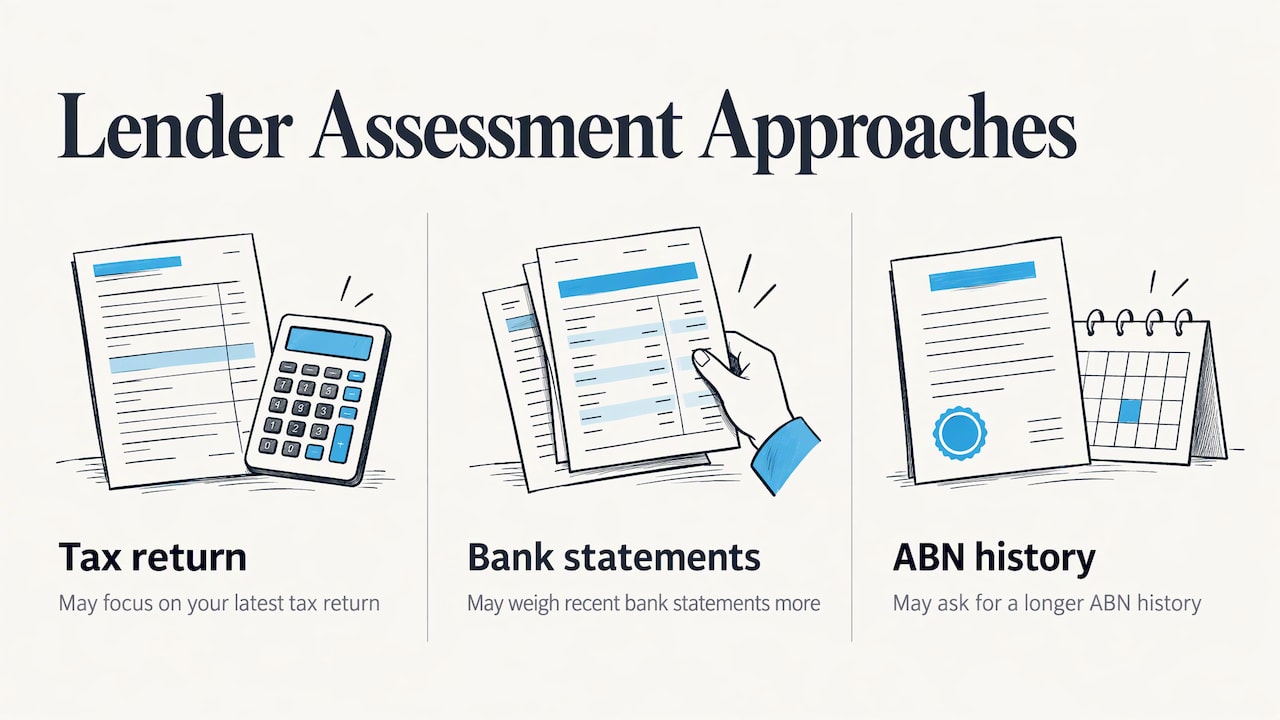
Lender policies on self employed income are not uniform. One may focus heavily on your latest tax return. Another may put more weight on recent bank statements. Another may ask for a longer history in your ABN. The same application can read quite differently depending on where it lands.
That is the practical argument for using a broker. Applying to several lenders yourself means filling in several forms, and each full application can leave a mark on your credit file. A broker who knows the policies in advance can point you to the lenders that may suit your situation before you apply, so you are not guessing.
How AFH Finance works
Here is the process, as we run it:
- Start online. You answer a short set of questions.
- See indicative repayments. These give you a sense of the range before any conversation.
- A real broker calls you. Not a call centre. The broker confirms the options that may suit your situation.
- Fees are explained in writing before you go ahead. AFH is paid by lenders, and a broker fee may be added to the loan.
Checking your options is a soft enquiry, no credit score impact. No cost to check your options.
AFH Finance is a broker, not a lender. Rates, terms and conditions are set by the lender.
Our perspective
Self employed Australians are often told their income is “too hard” to assess. We see it differently. The income is real. It just needs to be explained in the way a particular lender reads it.
That is why we think a broker is the sensible place to start. A real broker at AFH Finance looks at how your income is structured and compares a panel of 40+ lenders, so you are not working out each lender’s policy yourself. We are built for employed Australians and ABN holders, and that is the lens we bring to every conversation.
We also think the money conversation should be plain. Fees are explained in writing before you go ahead. We are paid by lenders, and a broker fee may be added to the loan. You should know that before anything proceeds, and you will.
Rated 5.0 on Google from 57 reviews, with 750+ borrowers helped, we have learned that the borrowers who feel most in control are the ones who talk through their situation early with a broker, before they lodge a single application.
AFH Finance
Check your options with a broker
If you are a sole trader or ABN holder planning a renovation, travel or another major purchase, our Personal Loans page explains how we compare lenders for you. Start online with a short set of questions, see indicative repayments, then a broker calls to confirm the options that may suit you. No cost to check your options. Soft enquiry, no credit score impact.
Buying a vehicle for your business instead? Our business loans and equipment finance page covers vehicles, trucks and equipment for ABN holders. For detail on how asset finance works, see our guides to equipment business loans and machinery finance.
Managing repayments when income moves
Getting the loan is one step. Living with the repayments through a slow quarter is the real test, so plan for it from day one.
- Build a buffer. Setting aside money in strong months gives you a cushion for weak ones. Moneysmart’s self employment guidance supports regular reviews of income and expenses.
- Set aside tax. Self employed income arrives before tax is paid. Money intended for the ATO should not be counted as money for repayments.
- Align repayment dates with your cash flow. Ask a broker about repayment frequency and flexibility, since lenders offer different options.
- Keep records current. Up to date accounts make any future application, whether for a car, caravan or another purpose, simpler.
If a repayment is going to be a struggle, contact your lender early rather than waiting. The Australian Banking Association’s hub on personal loan assistance explains what support may be available.
FAQ
Can I get a personal loan if I am self employed in Australia?
Yes. Self employed Australians, including sole traders and ABN holders, can apply for personal loans. Lenders look for documented, ongoing income, usually through tax returns and bank statements. Policies differ by lender, so a broker can help you compare lenders that may suit your situation.
What documents do I need for a self employed personal loan?
Commonly, lenders ask for your latest individual tax return, the ATO Notice of Assessment, recent bank statements and identification. Some also ask for profit and loss statements. The list depends on the lender, so ask your broker what applies to the options you are considering.
Will checking my options affect my credit score?
At AFH Finance, checking your options is a soft enquiry, no credit score impact. A full application to a lender is a separate step, and your broker explains what that involves before anything proceeds.
Does it cost anything to use a broker?
No cost to check your options. AFH is paid by lenders, and a broker fee may be added to the loan. We explain any fee in writing before you go ahead.
What interest rate will I pay?
Rates are set by the lender based on your situation. Moneysmart notes that lenders consider things like credit score, income, expenses and savings. A broker can talk you through the options that may suit you.
Sources
- Personal loans, Moneysmart
- Self employment, Moneysmart
- Personal loans or buy now pay later, Australian Banking Association
- Updated responsible lending guidance, ASIC RG 209 summary
- Business expense management for contractors
Recommended
- Unsecured Personal Loans in Australia: How They Work
- Personal Loans Australia | Personal Loan Broker
- Business Loans & Equipment Finance Australia
See your options from our panel of 40+ lenders
Soft enquiry, no credit score impact. No cost to check your options.
Compare my optionsGeneral information only. This article doesn't consider your objectives, financial situation or needs, and isn't a credit offer. Lending criteria, fees and charges apply. We're paid by lenders, and a broker fee may be added to your loan. AFH Finance Pty Ltd, Credit Representative 548852 of Access Lending Group Pty Ltd, ACL 531308.