
Refinancing a personal loan means taking out a new loan and using it to pay out your existing one. Whether it works in your favour depends on three things: the rate the new lender sets for your situation, the fees on both loans, and the length of the new term. A broker can compare lenders that may suit you across those points in one conversation. AFH Finance is an Australia wide broker with a panel of 40+ lenders, and checking your options is No cost to check your options, with a Soft enquiry, no credit score impact.
See your options from our panel of 40+ lenders
Soft enquiry, no credit score impact. No cost to check your options.
Compare my optionsThis guide covers what refinancing involves, the costs that can tip it either way, the steps from start to finish and what lenders look at. It is general information only, not personal advice.
AFH Finance
afhfinance.com.au
Compare Personal Loan Options
AFH Finance compares personal loan options from a panel of 40+ lenders, with indicative repayments and a soft enquiry that has no credit score impact.
TL;DR
Refinancing replaces your current personal loan with a new one, at the same lender or a different one.
A lower weekly or monthly repayment can still cost more overall if the term is longer or the fees are higher.
Compare the rate, every fee (including early repayment fees on your old loan), the term and whether extra repayments are allowed.
Rates are set by the lender based on your situation, so the advertised rate may not be the one you receive.
A broker can compare lenders that may suit you. AFH is paid by lenders and a broker fee may be added to the loan, always explained in writing before anything proceeds.
Table of Contents
What refinancing a personal loan actually means
Moneysmart, the Australian Government’s money information service, describes refinancing as replacing or extending an existing loan with a new one, either with the same lender or a different one. In practice, the new lender pays out the balance of your old loan and you start repaying the new one under new terms.
The regulator ASIC lists the usual reasons in its responsible lending guide, Regulatory Guide RG 209: getting better terms or features, switching lenders, or upgrading something that was financed. For a personal loan, that tends to come down to a few practical goals:
A repayment amount or frequency that fits your pay cycle better.
A different loan structure, such as fixed or variable.
Features you did not have before, such as the ability to make extra repayments.
Moving to a lender whose terms suit your current circumstances.
Notice what is missing from that list: any promise that the loan will cost less. Whether it does depends on the numbers, which is why the comparison step matters more than the decision to look.
When it may be worth looking at your options
People often start thinking about refinancing when something has changed since they first borrowed. Common triggers include:
Your income has changed. You moved from part time to full time work, started a new job, or began earning through an ABN. Lenders assess employed applicants and ABN holders on different documents, so your options may look different from when you first borrowed.
Your repayment history is solid. If you have kept your repayments up to date, some lenders may view a refinance more favourably. ASIC’s guide says a refinance is more likely to be suitable where the borrower has a good payment history, the repayments are lower and nothing adverse has changed.
Your loan lacks flexibility. Perhaps you want to make extra repayments or change how often you pay.
The market has moved. Lender pricing changes over time, and the RBA’s cash rate decisions are one of the things that influence it. The RBA publishes its decisions after each board meeting, so check its site for the latest.
There is also a situation where refinancing is unlikely to be suitable. ASIC says a refinance is prima facie unsuitable where a borrower is in arrears and the new repayments would be at the same or a similar level. If you are struggling with repayments, speak to your current lender about hardship options, or contact the National Debt Helpline on 1800 007 007, before applying for anything new.
The costs that decide whether refinancing works
The headline repayment is the number people notice first. It is rarely the whole story. Moneysmart warns that refinancing can cost more if the new interest rate or fees are higher, or the loan term is longer. Its own example is a $20,000 debt moved to a lower rate over a longer term: the weekly repayment falls, but the total cost can rise.
A simple illustration of the term effect
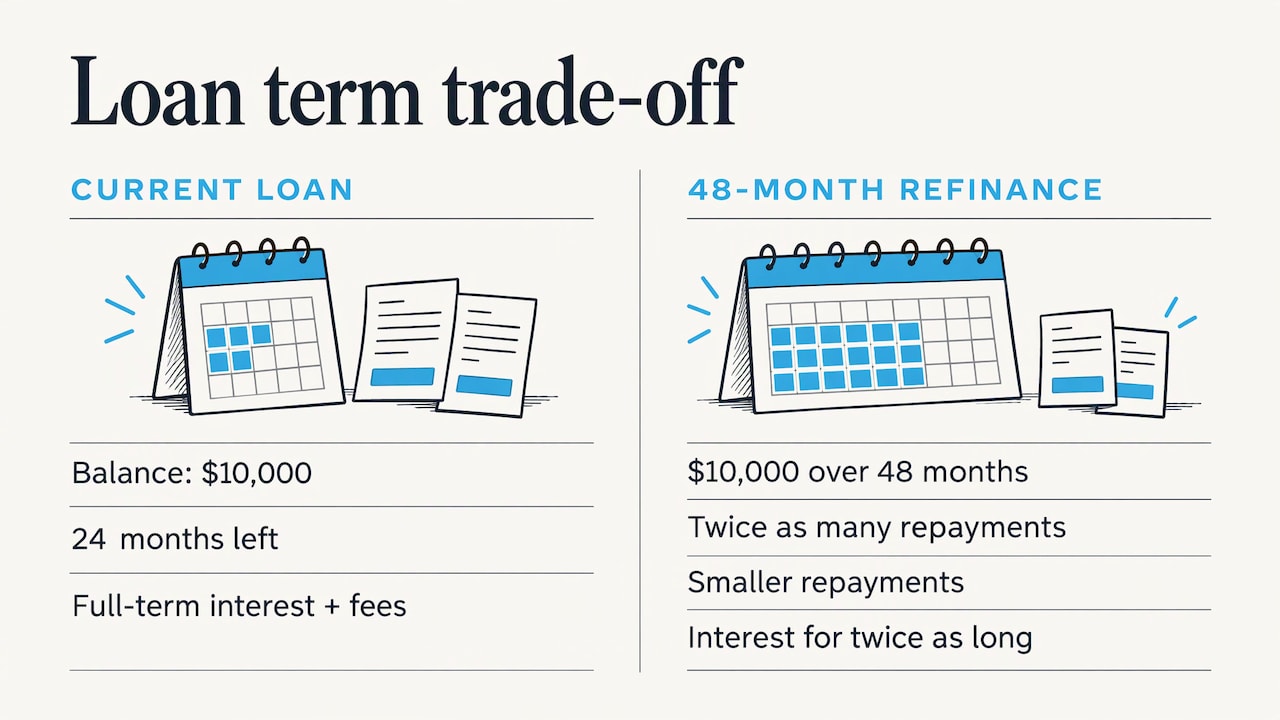
Take a balance of $10,000 with 24 months left. If a new loan stretches that balance over 48 months, you make twice as many repayments. Each repayment is smaller, which can feel like relief, but you are paying interest for twice as long. A lower rate may or may not offset that. The only way to know is to add up what you will pay across the full term on both options, including fees. The rate itself is set by the lender based on your situation, so work from the figures in your own written offer, not a headline advertisement.
Fees on both sides
Moneysmart lists the fees to look for on personal loans: application or establishment fees, administration fees, missed payment or default fees, early repayment fees and other costs such as balloon payments. It also notes that the rate you receive may differ from the advertised rate, depending on your credit score, income, expenses and savings.
When you refinance, two sets of costs apply:
Costs of leaving your current loan. Ask your current lender for a payout figure and whether an early repayment or discharge fee applies.
Costs of starting the new loan. This includes establishment fees, ongoing fees and, if you use a broker, any broker fee.
ASIC’s guide expects lenders assessing a refinance to work out the cost of paying out the existing product, such as discharge or break fees, plus associated costs such as brokerage fees, and to consider overall costs including all transaction fees and charges. You should do the same sum yourself.
The comparison rate
Moneysmart explains that the comparison rate bundles interest and most fees into one percentage, and its worked example shows a loan with a lower interest rate can cost more overall than one with a lower comparison rate. Use it as one tool alongside the full fee list, not instead of it.
A checklist for comparing refinance options
Moneysmart suggests listing your current debt details first, then asking each new lender the same set of questions. Here is that approach laid out as a table you can work through.
| What to compare | Your current loan | The new option |
|---|---|---|
| Balance owing | Payout figure from your lender | Amount the new loan would cover |
| Interest rate | Your current rate | Rate set by that lender for your situation |
| Fixed or variable | Which you have now | Which is offered |
| Fees | Early repayment or discharge fee | Establishment, ongoing and broker fees |
| Remaining or new term | Months left | Months proposed |
| Repayment amount and frequency | What you pay now | What you would pay |
| Extra repayments | Allowed or not | Allowed without a penalty or not |
| Total you will repay | Remaining repayments plus fees | All repayments plus all fees |
The last row is the one that decides it. If the new total is not lower, ask what you are getting in exchange, such as a more manageable repayment or a feature you need.
Moneysmart also advises a stress test. Check you could still afford the repayments if rates rise (it suggests a rise of a few percentage points for a variable rate loan), if your income drops or if living costs go up. Our repayment calculator gives indicative repayments to help you test different terms.
The steps to refinance a personal loan
The process is straightforward when you take it in order.
Get your current loan details. Find your contract and latest statement: balance, rate, fees, remaining term and repayment. Request a payout figure from your lender. Where it goes wrong: using the balance on your statement rather than the payout figure, which can include extra charges.
Define what you want to change. A different repayment, a different structure, or a feature like extra repayments. Without a goal, every offer looks the same.
Gather your documents. Employed applicants typically need ID and recent payslips, and ABN holders typically need income documents such as tax returns and business statements. Lenders set their own requirements, so a broker can tell you what each one asks for.
Compare lenders that may suit you. Look across the rate, fees, term and features using the table above. Doing this alone means visiting several lender sites and reading different fee schedules. A broker does the comparison across a panel for you.
Check the offer in writing. Read the full terms, including every fee, before you go ahead. Ask what happens to your old loan and when it will be paid out.
Apply and keep paying until the old loan is closed. Keep making repayments on your existing loan until the new lender confirms it has been paid out. A missed repayment during the changeover can add fees and affect your repayment history.
Confirm the old loan is closed. Ask for written confirmation that the balance is zero, and check that any direct debits to the old lender have stopped.
A broker can work through these steps with you. At AFH, you start online with a short set of questions, see indicative repayments, and a real broker calls you back to confirm options that may suit your situation. Fees are explained in writing before you go ahead.
What lenders check when you apply
Lenders must make reasonable inquiries before offering credit. For a refinance, ASIC’s RG 209 says that includes getting details of your current contract, such as the rate and fees, checking your repayment history and assessing whether the new loan is suitable for you. The guide says lenders should look at repayment history over a long enough period, for example 12 months, and at other signs of financial stress, such as rising credit use or overdue utility bills.
In practical terms, lenders look at:
Your repayment history on the existing loan.
Your income and how stable it is.
Your living expenses and other commitments.
Your credit score and credit file.
The March 2025 update to RG 209 also added guidance on how HELP debts are treated in credit assessments, so mention any HELP debt when you apply.
Two habits help before you apply. Keep every repayment on time, and check your own credit report so there are no surprises. Each full application a lender makes can be recorded on your credit file, which is one reason many borrowers start with a Soft enquiry, no credit score impact to see their options first.
Refinancing with security attached
Some refinance options involve putting an asset behind the loan. Moneysmart warns that turning unsecured debt into a secured debt can put your home or car at risk, because the lender can sell the asset to recover the money, and advises considering all other options before using assets as security. If a secured structure is suggested, ask what happens if you cannot meet repayments, and talk to a broker about your situation before deciding. Our guide to unsecured personal loans explains the difference in plain terms.
Why use a broker to compare personal loan options
The hard part of refinancing is not filling in a form. It is knowing which lenders to look at, reading each fee schedule and keeping the comparison like for like. A broker deals with that comparison across many lenders and explains the terms in writing.
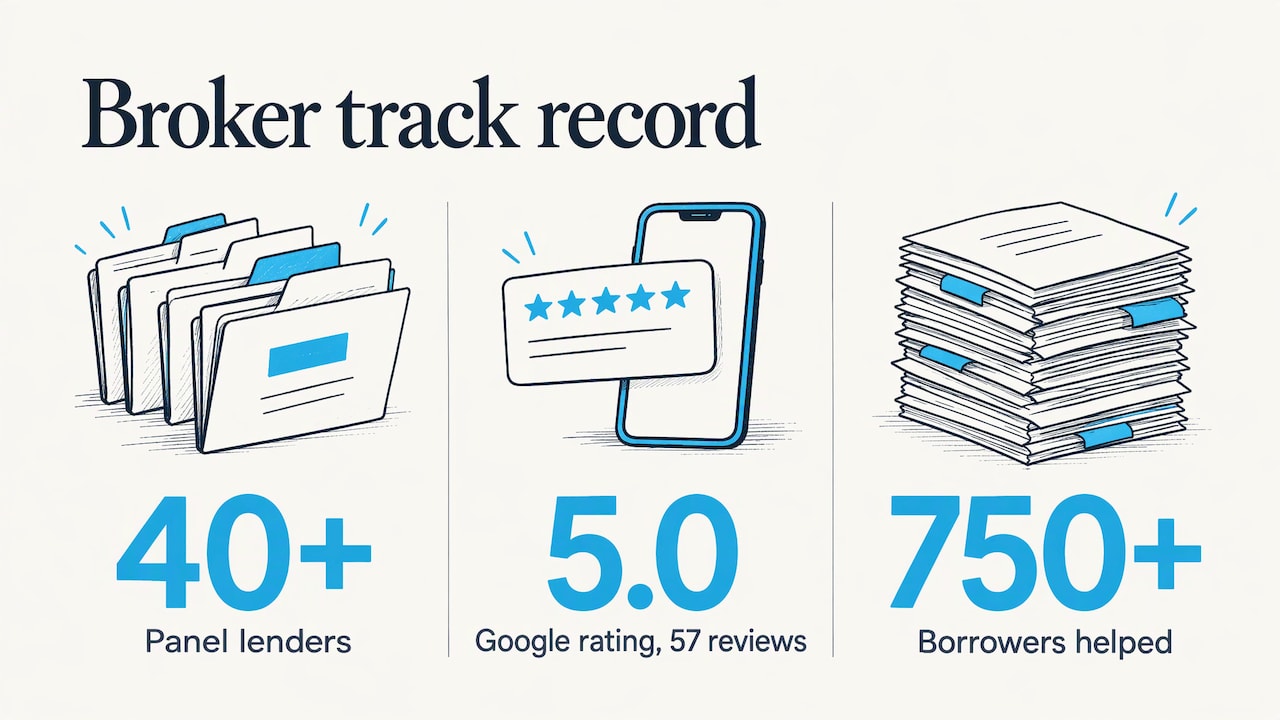
At AFH Finance, a real broker, not a call centre, compares our panel of 40+ lenders for employed Australians and ABN holders, Australia wide. We are rated 5.0 on Google from 63 reviews, with 750+ borrowers helped. AFH is a broker, not a lender: lenders set the rates and decide on each application based on your situation.
AFH is paid by lenders, and a broker fee may be added to the loan. That is always explained in writing before anything proceeds, which makes it a line you can add to the comparison table above.
Compare personal loan options with a broker
If you are weighing up a refinance, our personal loans page shows how it works. You answer a short set of questions online, see indicative repayments, and a broker calls to talk through lenders that may suit you. It is No cost to check your options, with a Soft enquiry, no credit score impact.

Personal loans through AFH cover planned purchases such as renovations, travel and weddings. If your loan is for a vehicle, see car loans or caravan loans. Sole traders and companies can look at business loans and equipment finance.
Our view: compare the whole cost, not just the repayment
Most people who ask us about refinancing start with one question: what will my repayment be? It is a fair place to begin, but it is only one line of the comparison.
We would rather you looked at the full picture: the rate the lender sets for your situation, every fee on the old and new loan, the term and whether you can make extra repayments. Our formula for helping is to put those points side by side, in writing, so the decision is yours and it is an informed one.
That is why we work as brokers across a panel of 40+ lenders rather than offering a single product. Employed Australians and ABN holders have different documents and different circumstances, and a real broker can look at lenders that may suit each one.
Talk to a broker about your own situation before you decide. This article is general information, and the right structure depends on details only you have.
AFH Finance
FAQ
Is refinancing a personal loan a good idea?
It depends on the numbers. Refinancing can suit you if the new loan has terms or features that fit your situation better and the total cost across the full term works for you. Moneysmart notes it can cost more if the rate or fees are higher or the term is longer, so compare the total, not just the repayment.
Can I refinance a personal loan with a different lender?
Yes. Moneysmart describes refinancing as replacing an existing loan with a new one at the same or a different lender. The new lender applies its own criteria and pays out your old loan. A broker can compare lenders that may suit you.
Will checking my options affect my credit score?
Checking your options with AFH is a Soft enquiry, no credit score impact. A full application to a lender is a separate step, and your credit file may record it. Talk to a broker about how the process works for your situation.
Does it cost anything to use a broker?
No cost to check your options. AFH is paid by lenders, and a broker fee may be added to the loan. Any fee is explained in writing before anything proceeds.
What documents do I need?
Lenders set their own requirements. Employed applicants are usually asked for ID and recent payslips, and ABN holders for income and business documents. Your current loan contract and a payout figure from your lender are useful in both cases.
Sources
Recommended
See your options from our panel of 40+ lenders
Soft enquiry, no credit score impact. No cost to check your options.
Compare my optionsGeneral information only. This article doesn't consider your objectives, financial situation or needs, and isn't a credit offer. Lending criteria, fees and charges apply. We're paid by lenders, and a broker fee may be added to your loan. AFH Finance Pty Ltd, Credit Representative 548852 of Access Lending Group Pty Ltd, ACL 531308.