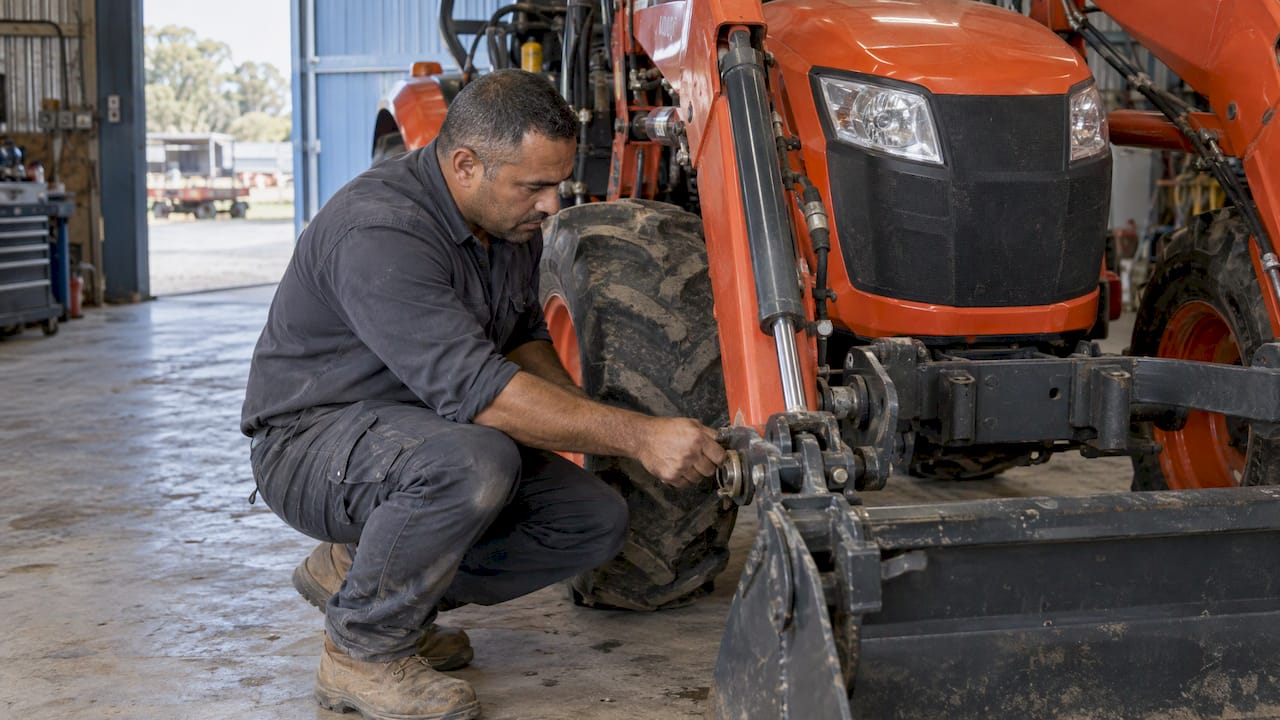
Machinery finance lets an Australian business acquire plant, equipment or a work vehicle and pay for it over time instead of paying the full price upfront. The asset usually secures the loan, and the structure you choose decides who owns the machine, how GST is handled and what happens at the end of the term. A machinery loan is one common way to do it. This guide explains the main structures, what lenders look at, the costs to compare and the tax points that apply from 1 July 2026. It is general information only, not personal advice.
See your options from our panel of 40+ lenders
Soft enquiry, no credit score impact. No cost to check your options.
Compare my optionsAFH Finance
Compare Machinery Finance Options
AFH Finance compares business finance options from a panel of 40+ lenders, with indicative repayments shown when you check online.
TL;DR
- Machinery finance is a loan or lease used to buy or use business equipment, with the machine itself normally acting as security.
- The main structures are a chattel mortgage, hire purchase, finance lease and a standard secured loan. They differ on ownership, GST and end of term options.
- Lenders assess your ABN, trading history, the asset and your capacity to repay. Rates and terms are set by the lender based on your situation.
- Compare total cost, fees, term, balloon payments and tax treatment, not only the repayment amount.
- AFH Finance is a broker, not a lender. We compare a panel of 40+ lenders, and there is no cost to check your options.
Table of Contents
- What machinery finance is and how a machinery loan works
- The main machinery finance structures
- New, used, auction and private sale machinery
- What lenders assess for a machinery loan
- How much can you borrow, and what deposit might be needed
- Costs and fees to compare
- Tax and GST points for machinery purchases
- What to compare before choosing
- Comparing machinery finance with AFH Finance
- FAQ
- Sources
What machinery finance is and how a machinery loan works
With machinery finance, a lender pays the seller (a dealer, an auctioneer or a private seller) and you repay the lender in instalments over an agreed term. The machine is typically the security for the loan, which is why lenders often look at the asset as closely as they look at the business.
The kinds of machinery people finance are wide: excavators and skid steers, tractors and farm equipment, forklifts, commercial kitchen fit outs, printing presses, CNC machines, trucks, trailers and work utes. If it earns income for your business and holds a resale value, a lender may be willing to consider it.
The basic mechanics are the same whichever structure you choose:
- You pick the machine and agree a price with the seller.
- A lender funds the purchase, in full or in part.
- You make regular repayments for a set term.
- At the end, you own the asset, return it or refinance it, depending on the structure.
Because machinery finance is business lending, the repayment needs to be funded by the cash flow the machine helps generate. Only you and your accountant know whether the numbers work, so it is worth talking to a broker and your accountant about your own situation before committing.
The main machinery finance structures
Most machinery finance in Australia falls into a handful of structures. The names vary between lenders, but the differences come down to ownership and tax treatment.
| Structure | Who owns the machine | Typical feature | Worth asking about |
|---|---|---|---|
| Chattel mortgage | You, from day one | Lender holds a registered interest until the loan is repaid | GST credits, depreciation, balloon option |
| Hire purchase | The financier until the final payment | You use the machine while you pay it off | Ownership transfer and tax treatment |
| Finance lease | The lessor | You pay to use the machine for the term | End of term choices and residual value |
| Secured business loan | You | Machine or other assets used as security | Security requirements and fees |
Chattel mortgage
A chattel mortgage is a popular choice for machinery because the business takes ownership of the asset straight away and uses it as security. That ownership is what opens access to GST credits, interest deductions and depreciation claims, subject to your circumstances. Terms commonly run from one to seven years, and a balloon payment at the end can lower the regular repayment. Ask your accountant how this applies to your business.
Hire purchase
With hire purchase, you have the use of the machine while you pay it off, but ownership passes to you only after the final payment. It can suit businesses that want a predictable path to owning the asset without a large upfront outlay.
Finance lease
A lease means the lessor owns the machine and you pay for the right to use it. It can suit equipment that changes quickly, such as technology heavy machinery that you expect to upgrade. At the end of the term, the options usually include returning the asset, extending the lease or buying the machine, depending on the contract.
Secured business loan
A standard secured loan gives you funds to buy the machine, with the machine or another asset as security. It can be more flexible when the purchase includes extras such as attachments, delivery or installation.
Which of these is suitable depends on your tax position, cash flow and plans for the asset. A broker can explain how each one works with the lenders that may suit you.
New, used, auction and private sale machinery
Many operators do not buy brand new. Finance can often be arranged for machinery from several sources, and lenders treat each a little differently.
- New machinery from a dealer. The simplest path. The dealer supplies an invoice and specifications, and the lender has a clear value for the asset.
- Used machinery from a dealer. Lenders usually look at age, hours or kilometres, and condition. Older machines may attract shorter terms or different conditions.
- Auction purchases. Timing matters because auction payment deadlines are tight. It helps to talk to a broker before you bid, so you know which lenders may suit and what documents they will want.
- Private sale. Possible with many lenders, but they usually want extra evidence of the machine’s identity and ownership, such as serial numbers and proof the seller owns it outright. Private sale purchases tend to need more paperwork than dealer sales.
At AFH Finance, our business finance covers vehicles, trucks and equipment for ABN holders, and our car finance covers dealer and private sale purchases. Details are on our business loans and equipment finance page.
What lenders assess for a machinery loan
Every lender has its own policy, so we can only describe the common areas. These are the things you can prepare ahead of time.
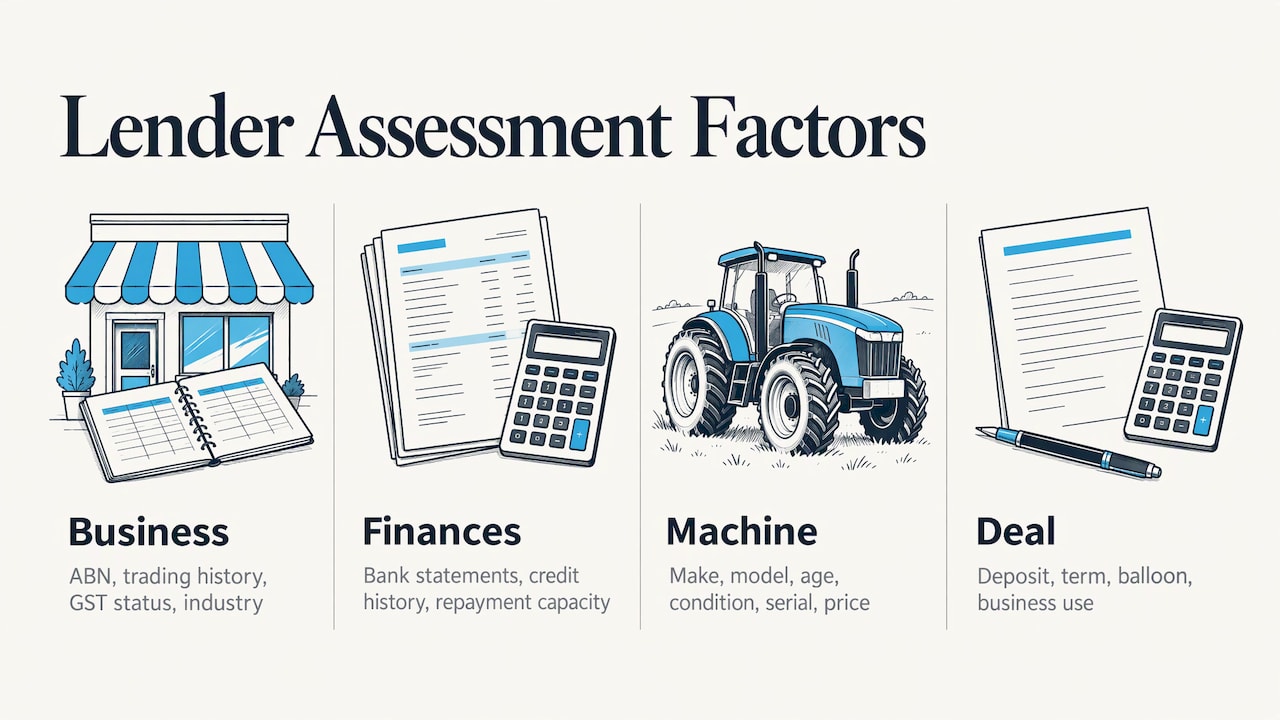
Your business. Lenders usually look at your ABN, how long you have been trading, your GST registration status and the industry you work in. Employed Australians who also hold an ABN, and sole traders, are common applicants, and many lenders have policies for them.
Your financial position. Expect to provide documents such as bank statements, and sometimes BAS statements, tax returns or financial statements, depending on the amount and the lender. Lenders also review credit history, existing commitments and the capacity to make repayments.
The machine. Make, model, age, condition, serial number and price all matter. A machine with a strong resale market is easier to secure against than a highly specialised one.
The deal itself. Deposit, term, balloon amount and whether the machine will be used for business purposes all shape what a lender may offer.
Rates are set by the lender based on the borrower’s situation, so two businesses buying the same machine can be offered different terms. That is one reason to compare several lenders rather than relying on one.
How much can you borrow, and what deposit might be needed
We cannot tell you how much you should borrow, and we do not give personal advice. What we can say is how the pieces usually fit together.
The amount a lender will consider depends on the asset value, your capacity to repay and the lender’s policy. Some structures can fund up to the full purchase price of the asset, while other lenders may ask for a deposit, particularly for older machinery, private sales or more specialised equipment. A trade in or existing equity can sometimes serve as the deposit.
A sensible planning step is to work backwards from your cash flow. Ask yourself what the machine will realistically contribute each month, and whether your business could still meet repayments in a quiet period. Our repayment calculator shows indicative repayments so you can see how term and balloon choices change the monthly figure. The result is an indication only, and the lender sets the actual rate and terms.
Costs and fees to compare
A low repayment is not the whole story. When you compare machinery finance options, look at the full cost across the term.
- Interest rate and total interest. Set by the lender based on your situation. Compare the total repaid over the term, not only the monthly figure.
- Establishment and account fees. Some lenders charge upfront fees or ongoing account keeping fees.
- Broker fee. AFH is paid by lenders, and a broker fee may be added to the loan. We explain any fee in writing before anything proceeds.
- Balloon or residual payment. A balloon lowers regular repayments but leaves a lump sum due at the end of the term.
- Early repayment conditions. Ask what happens if you want to pay out the loan early or sell the machine.
- Insurance requirements. Lenders generally require the asset to be insured while they hold security over it.
- Fixed or variable terms. Fixed repayments give certainty, while variable terms can move.
Put two or three options side by side with the same term and balloon, so the differences are clear.
Tax and GST points for machinery purchases
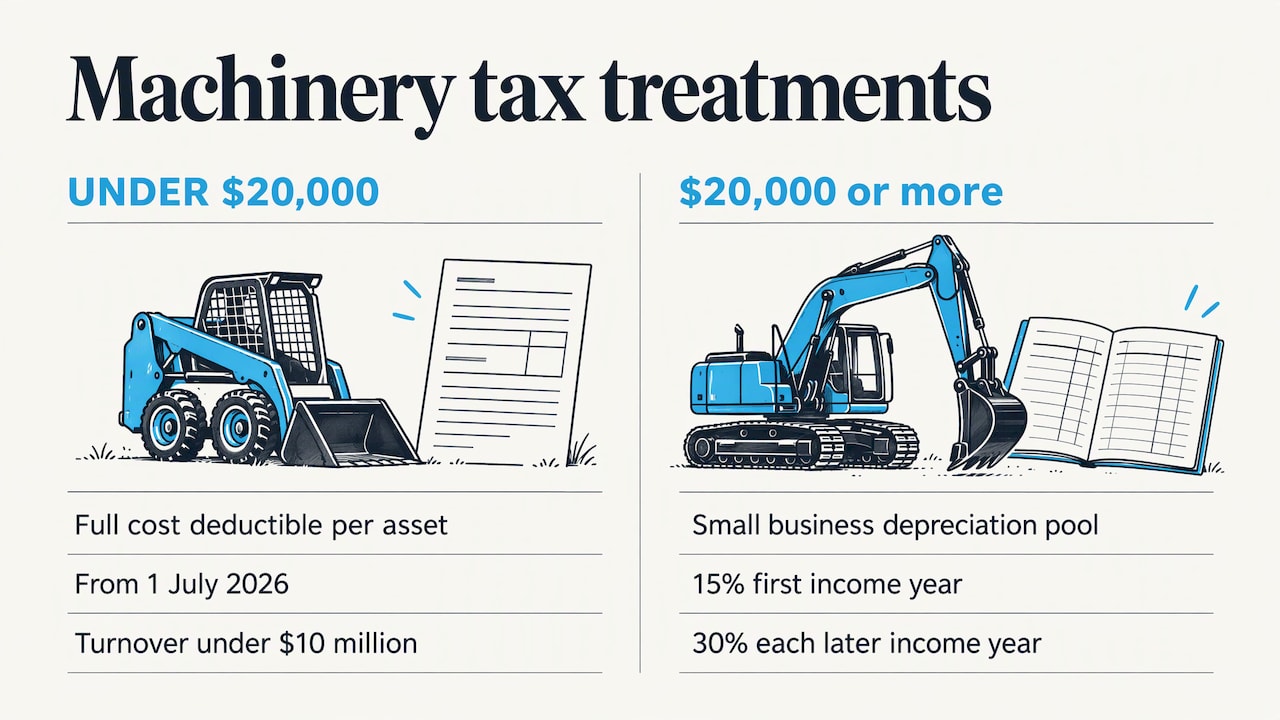
Tax is where machinery finance can matter most, and it is where you should lean on your accountant. One point worth knowing is the small business write off. According to the ATO, from 1 July 2026 small businesses with aggregated turnover under $10 million can deduct the full cost of eligible depreciating assets costing less than $20,000 that are first used or installed ready for use in an income year. The limit applies per asset.
For assets that cost $20,000 or more, the same ATO page explains that they can go into the small business simplified depreciation pool, depreciated at 15% in the first income year and 30% each income year after.
What this means in practice is that the price of a machine, and whether you finance it with a structure that gives you ownership, can affect when and how you claim. GST treatment also differs between structures. Speak to your accountant or the ATO about how these rules apply to your business, because eligibility depends on your turnover and how the asset is used.
Once the machine is working, protecting its value matters as much as claiming it. A planned approach to servicing, such as the one explained in this guide to preventive maintenance costs and returns, helps you keep downtime and repair surprises in view when you budget for repayments.
What to compare before choosing
Use this checklist when you have two or more options in front of you:
- Ownership. Do you own the machine from day one, at the end, or never?
- Tax and GST treatment. Has your accountant confirmed how it applies to you?
- Total cost. Add up repayments, fees and any balloon.
- Term against machine life. The term should not run well past the useful life of the machine.
- Flexibility. Can you make extra repayments, refinance or sell?
- Documents required. Which lenders need fuller paperwork, and which may suit a sole trader or newer business?
- Fees and commissions. Is every fee explained in writing before you go ahead?
Our view on machinery finance
Most business owners we speak with start with the machine and work out the finance later. We think the order helps if you flip it a little: look at how repayments sit against your cash flow first, then choose the structure.
That is where a broker earns their place. Lenders differ in how they treat sole traders, used machinery and private sale purchases, and it is hard to see those differences from the outside. At AFH Finance, a real broker, not a call centre, compares our panel of 40+ lenders for you, Australia wide, and talks you through the options that may suit your situation.
We are paid by lenders, and a broker fee may be added to your loan. We explain that in writing before anything proceeds. Checking your options is a soft enquiry, no credit score impact, and there is no cost to check your options. We have helped 750+ borrowers, and we are rated 5.0 on Google from 57 reviews.
AFH Finance
Comparing machinery finance with AFH Finance
If you are an ABN holder looking at a new or used machine, our business team can walk you through the structures above and the lenders that may suit you. You start online with a short set of questions, see indicative repayments, and a real broker calls you back to confirm the options. AFH Finance is a broker, not a lender, and rates are set by the lender based on your situation.
Explore business loans and equipment finance to get started, or see how we work across car loans and caravan loans if your purchase is a vehicle rather than a machine. Our broker details: AFH Finance Pty Ltd is Credit Representative 548852 of Access Lending Group Pty Ltd, ACL 531308.
FAQ
Is a machinery loan the same as equipment finance?
In practice, the terms are used interchangeably. Machinery finance is a type of equipment or asset finance focused on plant and machines, and it can use structures such as a chattel mortgage, hire purchase or a lease. The lender sets the terms based on the borrower’s situation.
Can I finance used machinery or a private sale purchase?
Often yes, though it depends on the lender. Used and private sale machinery usually needs more detail about the asset, such as age, condition and proof of ownership. Talking to a broker before you commit to the purchase helps you see which lenders may suit.
Do I need an ABN to apply?
Machinery finance is business lending, so lenders generally expect an ABN and look at how the business operates. AFH Finance is built for employed Australians and ABN holders, and a broker can explain what documents are typically needed.
Does checking my options affect my credit score?
With AFH Finance, checking your options is a soft enquiry, no credit score impact. A lender may run its own credit checks if you decide to proceed with an application, and a broker will explain this to you.
Sources
- ATO: $20,000 asset write off for small business
- Xero: Chattel mortgage guide for Australian businesses
- Preventive maintenance costs and returns
Recommended
See your options from our panel of 40+ lenders
Soft enquiry, no credit score impact. No cost to check your options.
Compare my optionsGeneral information only. This article doesn't consider your objectives, financial situation or needs, and isn't a credit offer. Lending criteria, fees and charges apply. We're paid by lenders, and a broker fee may be added to your loan. AFH Finance Pty Ltd, Credit Representative 548852 of Access Lending Group Pty Ltd, ACL 531308.