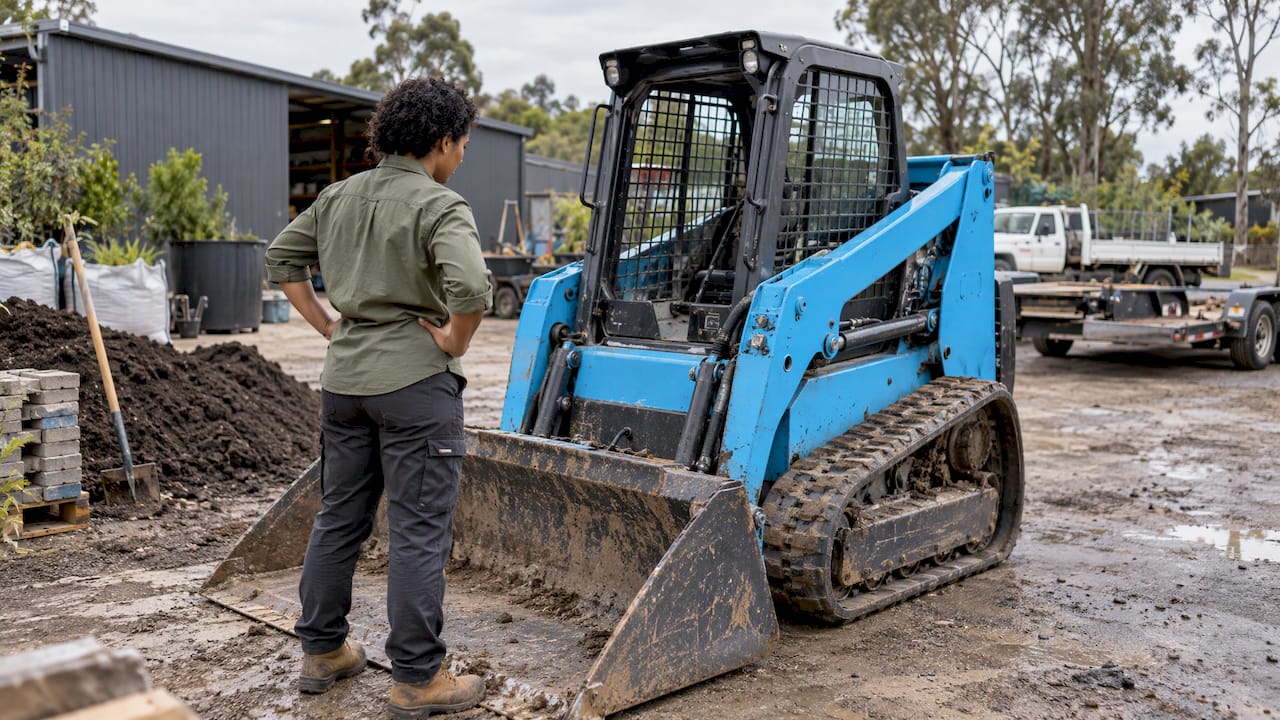
Equipment finance lets a small business pay for a ute, a coffee machine, a excavator attachment or a workshop compressor over time instead of finding the full price on day one. In Australia the main structures are an equipment loan, a chattel mortgage, hire purchase and a lease, and the right one depends on whether you want to own the asset, how you use it and how your tax is set up. Lenders each set their own criteria and their own rates based on your situation, so comparing across a panel is where a broker earns its place. At AFH Finance, a broker with access to 40+ lenders can compare options for ABN holders and businesses, with no cost to check your options.
See your options from our panel of 40+ lenders
Soft enquiry, no credit score impact. No cost to check your options.
Compare my optionsThis guide is general information only, not personal advice. It explains the structures, the tax rules that sit around them, what lenders ask for and how to compare options, so you can walk into a conversation with a broker knowing what to ask.
AFH Finance
afhfinance.com.au
Compare Finance for Business Equipment
AFH Finance helps ABN holders compare business finance options from a panel of 40+ lenders, with no cost to check your options.
TL;DR
- Equipment finance spreads the cost of vehicles, machinery and tools over regular repayments. The common structures are loans, chattel mortgages, hire purchase and leases.
- Buying and leasing suit different businesses. Ownership gives you control and resale value, while leasing can make upgrading easier and often bundles maintenance.
- For the 2025 to 26 income year the ATO allowed an immediate deduction for eligible assets costing less than $20,000 for businesses under $10 million turnover. The test is on the full cost of the asset.
- Rates and fees are set by the lender based on your situation, so two lenders can respond very differently to the same business.
- Checking options through AFH is a soft enquiry, no credit score impact, and there is no cost to check your options. AFH is paid by lenders and a broker fee may be added to the loan, always explained in writing before anything proceeds.
Table of Contents
- What equipment finance actually is
- Who uses it, and for what
- Buying or leasing: the decision that shapes everything else
- How the main structures differ in practice
- Tax rules that change how you think about equipment
- What lenders usually ask for
- What equipment finance costs
- How to compare equipment finance, step by step
- Common mistakes with small business equipment finance
- Where AFH Finance fits
- Our perspective
- FAQ
- Sources
What equipment finance actually is
Equipment finance is a loan or an agreement used to acquire a business asset. The asset might be a vehicle, a piece of machinery, a commercial kitchen fit out, a laser cutter or a set of tools. Instead of paying the whole price from cash flow, you make regular repayments over an agreed term.
The Australian Government’s business.gov.au lists loans, hire purchase, chattel mortgages and trade credit as ways to fund vehicles, equipment or tools. It also advises thinking about whether buying or leasing suits you better. In plain terms:
- Hire purchase means paying an item off in instalments.
- A chattel mortgage means borrowing money to buy the asset so that you own it.
- A lease means paying to use the asset for a set period, with ownership staying with the lessor.
- An equipment loan is a more general term for a loan used to buy equipment, often structured as one of the above.
The labels vary between lenders, which is one reason people searching for a small business equipment loan end up confused. The same piece of equipment can be financed on several structures, and each has different consequences for ownership, cash flow and tax.
Who uses it, and for what
Equipment finance is used by sole traders, partnerships and companies. A plumber buying a work van, a cafe owner replacing a espresso machine, a landscaper adding a mini loader and a physio clinic buying treatment equipment are all typical examples. AFH Finance’s business finance covers vehicles, trucks and equipment for ABN holders, so the same conversation can cover a ute for a sole trader and machinery for a larger operation.
Business.gov.au notes that non bank lenders often have more flexible loan criteria than traditional banks. That matters if you are newer to business, have irregular income or run through a sole trader structure. It also means the lender you approach first is not necessarily the lender whose criteria suit you.
Buying or leasing: the decision that shapes everything else
Before you compare lenders, decide what you want at the end of the term. Business.gov.au sets out the trade offs in its guide to leasing or buying vehicles and equipment.
Leasing
- You make regular payments, which makes budgeting predictable over time.
- Leasing companies usually handle repairs and maintenance.
- Upgrading to the latest equipment is generally easier and quicker, and you get more flexibility.
- Some brands or models may be unavailable, you cannot sell the asset, and you may need to keep paying for the full lease period even if you no longer need the equipment.
- Over the whole period you may pay more than buying upfront.
Buying (outright or through a loan, chattel mortgage or hire purchase)
- Buying upfront can cost less over the long run.
- You can modify the equipment to suit your work.
- As owner you can sell it to recover some of the cost, though outdated technology may fetch little.
A useful way to think about it is how fast the equipment loses its usefulness. A welder or a trailer tends to hold its value and its usefulness for years, which favours owning. Technology that dates quickly, such as imaging equipment, point of sale hardware or some digital printers, can make upgrade flexibility more attractive.
Whichever way you lean, work out what the asset earns for you. If you run service jobs, tracking job profitability shows whether a new machine is lifting your margins or simply adding a repayment. That number is more useful to a broker and to your accountant than a general sense that the business is busy.
How the main structures differ in practice
Chattel mortgage
You borrow to buy the asset and you own it from the start. This suits businesses that want to keep the equipment long term and treat it as their own asset. Because you are the owner, you can also sell it.
Hire purchase
You pay the item off in instalments. It is often used for vehicles and machinery where the aim is eventually to own the asset. Your broker can explain how a particular lender structures ownership and the final payment, and the terms are set out in the credit contract.
Lease
You pay for the use of the equipment. This can suit assets you expect to swap out, and business.gov.au notes that leasing companies usually handle repairs and maintenance. The trade off is that you cannot sell the asset and, as above, you may remain committed to the full lease period.
Unsecured business loan
Some small business owners use a general business loan for equipment, particularly for smaller items. Lender criteria vary, and a broker can show you which lenders on the panel offer which structure for your kind of purchase.
Car and ute purchases sit in a slightly different space. If you are buying a vehicle mainly for yourself rather than for the business, car loans may be the more natural fit. If the vehicle is a work asset bought through your ABN, business finance is the better place to start.
Tax rules that change how you think about equipment
Tax is often the reason a small business buys equipment when it does, so it deserves attention. The rules below are from the ATO. They change, so confirm the current income year with the ATO or your accountant before you commit.
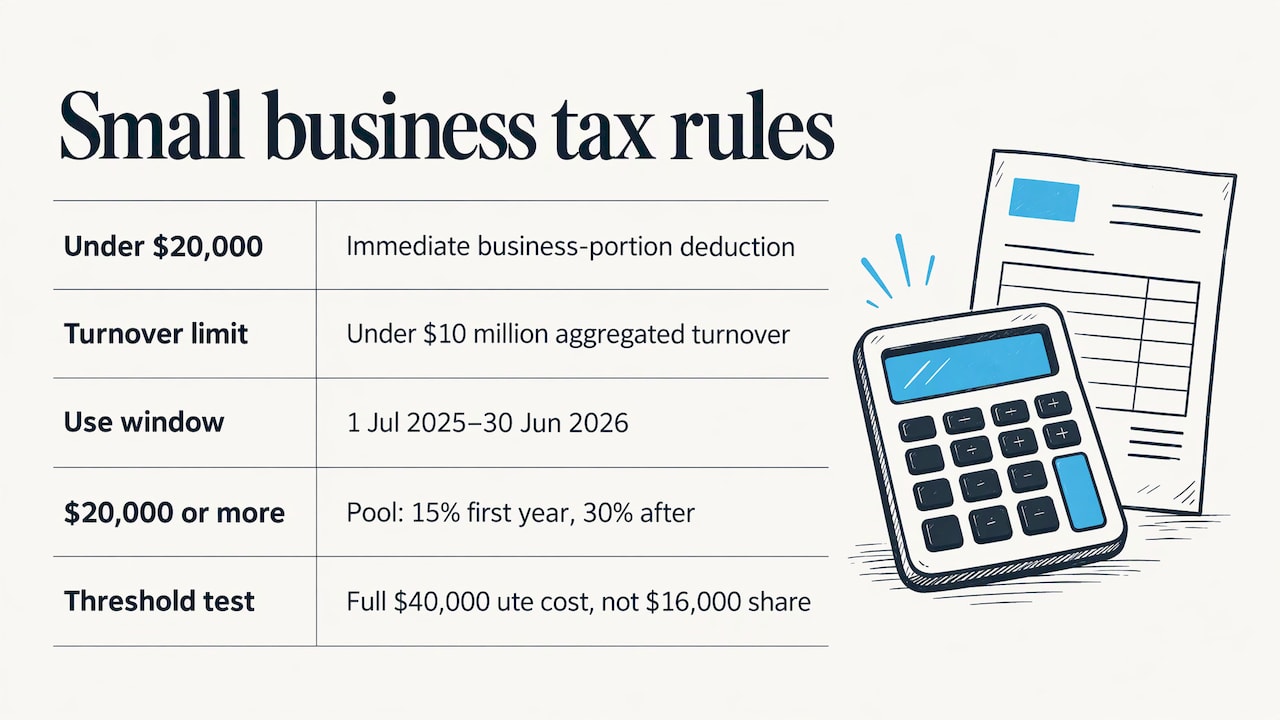
The $20,000 threshold. The ATO says that for the 2025 to 26 income year, businesses with aggregated annual turnover under $10 million can immediately deduct the business portion of eligible assets costing less than $20,000, provided the asset was first used or installed ready for use between 1 July 2025 and 30 June 2026. The limit applies per asset, so a business can claim several items, and it covers new and second hand assets. The ATO’s asset write off page shows the limit has been $20,000 for assets first used or installed ready for use on or after 1 July 2023.
Assets of $20,000 or more. The ATO says these can go into the general small business pool, where they are depreciated at 15% in the first income year and 30% in each following year. Its simpler depreciation rules apply to small businesses with aggregated turnover under $10 million.
The full cost is what counts. This is where owners get caught out. In the ATO’s own example, a ute with a total cost of $40,000 cannot use the $20,000 threshold even though only a $16,000 business use portion is deductible. Trade in credits are ignored when testing the limit, so the full purchase price before any trade in is what is tested.
So a $19,500 piece of equipment used entirely for business sits under the threshold, while a $24,000 machine does not, even if you trade something in against it. The threshold is also only available to eligible small businesses using the simplified depreciation rules, with exclusions and limits applying.
Two practical points follow. First, the date the asset is first used or installed ready for use matters, not the date you sign. Second, whether the threshold applies to a particular purchase, and how it interacts with the structure you choose, is a question for your accountant. A broker can explain finance options, but tax advice belongs with a registered tax professional.
What lenders usually ask for
Every lender has its own criteria, but the information they want is broadly consistent. Business.gov.au advises preparing comprehensive finance information for business loans, including financial and bank statements and cash flow projections. In practice, have these ready:
- Your ABN and details of how long the business has operated.
- Recent bank statements for the business account.
- Financial statements or tax returns, where you have them.
- The supplier’s invoice or written price for the equipment, including the make, model and year.
- Details of any existing finance commitments.
- Photo ID for the people involved.
Because lenders weigh these differently, the same application can land very differently across the panel. Some lenders look closely at trading history, others at the asset itself, others at cash flow. AFH Finance’s brokers work with applicants who are self employed as well as those on full time or part time wages, and explain the documentation in advance so there are fewer surprises once an application is lodged.
What equipment finance costs
The cost of equipment finance is more than the interest rate. When you compare, look at:
- The interest rate, which is set by the lender based on your situation. It is not a fixed price that every business receives.
- Establishment and ongoing fees, which differ by lender and are set out in the credit contract.
- Deposit or balloon arrangements, where a lender allows a final lump sum so repayments are lower during the term. Check what that final payment is and when it falls due.
- The term, because a longer term lowers each repayment but changes the total you pay over the life of the loan.
- Any broker fee. At AFH, the service is paid by lenders and a broker fee may be added to the loan, always explained in writing before anything proceeds.
Business.gov.au advises researching your options, understanding the agreement and considering advice from an accountant or business adviser. That is sound advice for any finance of this kind. A broker can set options side by side, and your accountant can tell you how they sit with your tax position.
How much to borrow is your decision and depends on your cash flow and plans. A broker can talk through how different structures affect repayments, but cannot and will not tell you what you should borrow.
How to compare equipment finance, step by step
- Define the asset. Write down exactly what you are buying, whether new or used, the supplier or private seller and the full price. Lenders treat a dealer sale and a private sale differently, so say which it is.
- Decide on ownership. Do you want to own the equipment at the end, or use it for a period and move on? That points you towards a chattel mortgage or hire purchase on one side and a lease on the other.
- Check the tax angle with your accountant. Look at the asset’s full cost against the $20,000 threshold and whether your turnover is under $10 million.
- Gather your documents. Bank statements, financials, the invoice and your ABN details make the process smoother. Without a broker you would repeat this paperwork lender by lender. With one, it is prepared once and presented across lenders that may suit you.
- Compare on total cost, not just repayment. Repayment size matters, but so do fees, the term and any final payment.
- Read the contract before signing. Make sure what is in writing is what was explained, including fees and what happens if you want to pay out early or if your circumstances change.
At step 4 and step 5, a broker does the heavy lifting. AFH Finance starts with a short set of online questions and shows indicative repayments. A real broker then calls you back to confirm the options that may suit your situation, drawing on a panel of 40+ lenders. If you want to see how that process works for equipment specifically, the AFH guides on equipment business loans, machinery finance and business asset finance go deeper on each. You can also read how an equipment finance broker works in Australia.
Common mistakes with small business equipment finance
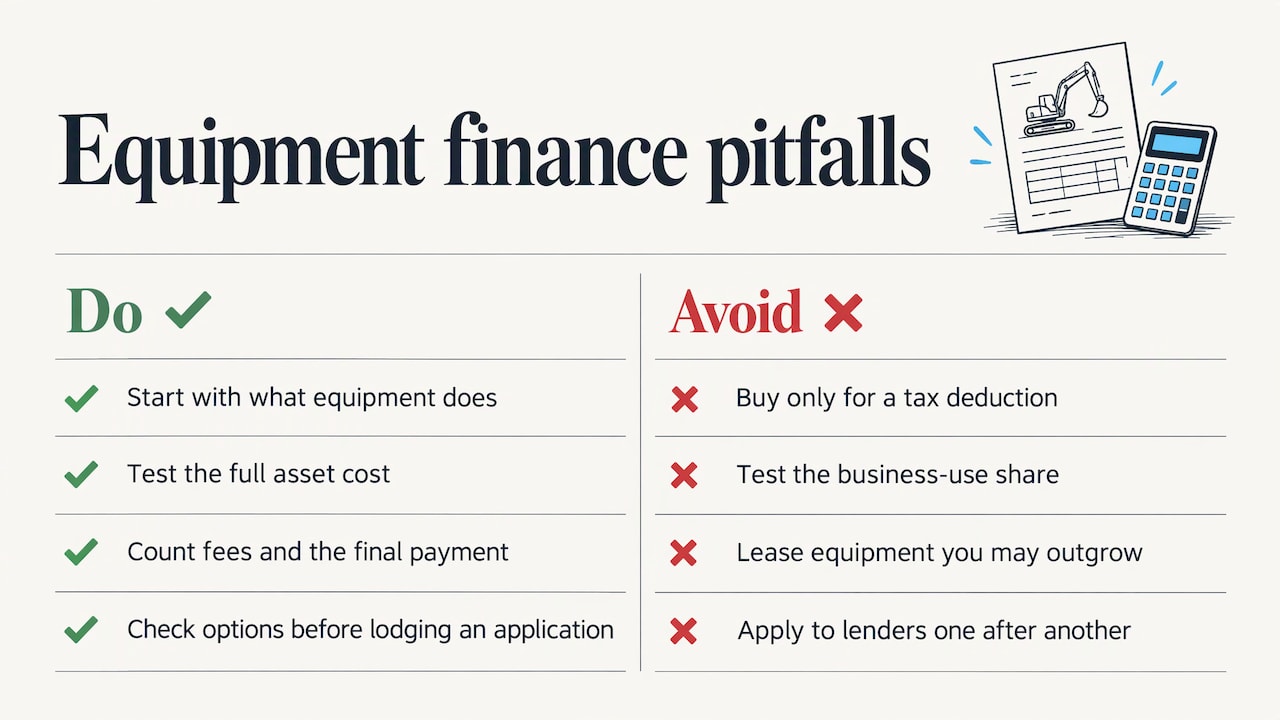
Treating the tax deduction as the reason to buy. A deduction reduces your taxable income. It does not make an unneeded purchase a good one. Start from what the equipment does for the business.
Testing the threshold on the wrong number. As the ATO’s ute example shows, the test is on the full cost, not the business use share, and trade ins do not reduce it.
Locking into a lease for equipment you may outgrow. If you may stop needing the asset, remember business.gov.au’s point that you may need to keep paying for the full lease period.
Skipping the fee detail. Two offers with similar repayments can differ once establishment fees, ongoing fees and a final payment are counted.
Applying to several lenders one after another. Each full application can leave a mark on a credit file. Checking options through AFH is a soft enquiry, no credit score impact, which lets you see what may suit you before anything is lodged.
Where AFH Finance fits
If you are an ABN holder buying a vehicle, truck or equipment, the business loans and equipment finance page is the place to start. You answer a short set of questions, see indicative repayments and speak to a real broker, not a call centre. AFH Finance is Australia wide, is rated 5.0 on Google from 57 reviews and has helped 750+ borrowers. There is no cost to check your options. AFH is paid by lenders and a broker fee may be added to the loan, always explained in writing before anything proceeds.
Other work vehicles and recreational purchases have their own pages: caravan loans and personal loans for planned purchases. For the full range of guides, see the AFH loan guides.
Our perspective
Most small business owners we hear from are not short of ambition. They are short of time. They know the ute, the oven or the machine they want, and the last thing they need is to rebuild the same application for five different lenders.
That is the case for using a broker. Lenders differ in how they treat a sole trader, a newer business, a private sale or a used asset, and a panel of 40+ lenders means your situation is looked at against many sets of criteria rather than one. A real broker compares the options that may suit you and explains the fees in writing before you go ahead.
Our advice is simple. Decide whether you want to own the asset, ask your accountant how the tax rules apply to your purchase, then talk to a broker about your situation. Rates are set by the lender based on your circumstances, so the useful step is to see the options, not to guess at them.
AFH Finance
FAQ
Can a sole trader get equipment finance?
Yes, ABN holders including sole traders can apply for equipment finance. Lender criteria differ, and some lenders look at trading history and cash flow more closely than others. A broker can show you which lenders on the panel may suit your situation.
Is a chattel mortgage the same as hire purchase?
They are related but not identical. Business.gov.au describes hire purchase as paying an item off in instalments and a chattel mortgage as borrowing to own the item. Your broker can explain how each lender structures ownership and the final payment.
Does checking my options affect my credit score?
At AFH Finance, checking options is a soft enquiry, no credit score impact. There is no cost to check your options. AFH is paid by lenders and a broker fee may be added to the loan, always explained in writing before anything proceeds.
Can I claim the equipment on my tax return?
The ATO says that for the 2025 to 26 income year, eligible small businesses with turnover under $10 million could deduct the business portion of assets costing less than $20,000. Assets of $20,000 or more can generally go into the small business pool. Check the current rules with the ATO or your accountant for your own situation.
Does AFH Finance lend the money?
No. AFH Finance is a broker, not a lender. AFH Finance Pty Ltd is Credit Representative 548852 of Access Lending Group Pty Ltd, ACL 531308, and compares options from a panel of 40+ lenders.
Sources
- Choose your funding, business.gov.au
- Leasing or buying vehicles and equipment, business.gov.au
- $20,000 asset write off for 2025 to 26, ATO
- Asset write off for eligible businesses, ATO
- Simpler depreciation rules for small business, ATO
- Job profitability tracking
Recommended
- Equipment Business Loan: How It Works in Australia
- Business Asset Finance in Australia: How It Works
- Equipment Finance Broker: How One Works in Australia
- Machinery Finance in Australia: Options, Costs and How to Compare
See your options from our panel of 40+ lenders
Soft enquiry, no credit score impact. No cost to check your options.
Compare my optionsGeneral information only. This article doesn't consider your objectives, financial situation or needs, and isn't a credit offer. Lending criteria, fees and charges apply. We're paid by lenders, and a broker fee may be added to your loan. AFH Finance Pty Ltd, Credit Representative 548852 of Access Lending Group Pty Ltd, ACL 531308.