
A dental loan is usually a personal loan used to pay for dental treatment. You borrow a fixed amount from a lender, pay the clinic, then repay the lender over an agreed term with interest and any fees. Other ways to spread the cost include clinic payment plans, no interest loans for people on low incomes, and government schemes for children. Which one suits you depends on the treatment, your budget and your situation, so this guide sets out how each works and what to check before you sign.
See your options from our panel of 40+ lenders
Soft enquiry, no credit score impact. No cost to check your options.
Compare my optionsThis is general information only, not personal advice. If you want to talk through your own situation, a broker can walk you through the options.
AFH Finance
Compare Personal Loan Options
AFH Finance helps Australians compare personal loan options from a panel of 40+ lenders, with broker support to talk through what may suit.
TL;DR
- A “dental loan” is normally a personal loan. The lender sets the rate and terms based on your situation, and you repay over a fixed term.
- Clinic payment plans often run over 6, 12 or 24 months, and they are a different product from a loan.
- Before accepting any agreement, check the interest rate, the comparison rate, fees, whether the rate is fixed or variable and any early repayment fee.
- Get a written, itemised quote from your dentist first, so you know the amount you are financing.
- Checking your options with AFH is a soft enquiry with no credit score impact. There is no cost to check your options.
Table of Contents
- What a dental loan is and how dental finance works
- Your options for paying for dental work in Australia
- How a personal loan for dental work is set up
- What dental finance costs
- Fixed or variable: which structure to look at
- Checklist before you accept a dental finance agreement
- Loan or payment plan: how to choose
- Our perspective on dental finance
- Comparing personal loan options with AFH
- Tips for ABN holders and the self-employed
- Smart habits when you borrow for treatment
- FAQ
- Next steps
- Sources
What a dental loan is and how dental finance works
In Australia, “dental loan” and “dental finance” are everyday terms rather than a single regulated product. They cover a few different ways of paying for treatment over time:
- A personal loan from a lender, with the money paid to you or the clinic and repaid in regular instalments.
- A dental payment plan, where you pay the clinic in instalments. According to one Australian payment plan provider, these may be offered in-house by a practice but are more commonly provided by third-party specialised companies.
- A government or community option, such as the Child Dental Benefits Schedule or a no interest loan, which only suit particular people.
The main difference is who you owe and on what terms. A personal loan is a credit contract with a lender. A payment plan is often tied to one clinic or one treatment. A personal loan is more flexible, because the money is yours to spend on the treatment you and your dentist have planned, though it is the lender that decides whether to lend and on what terms.
What dental work might a loan be used for
People commonly look at finance for larger or planned treatment where the cost is hard to meet in one go. Examples include implants, crowns and bridges, orthodontics such as braces or clear aligners, veneers and wisdom tooth surgery. Your dentist should be able to give you a written plan and an itemised quote, and that quote is the starting point for deciding how much finance, if any, you need to look at.
We don’t tell anyone how much to borrow. That depends on your budget, your treatment and your circumstances, and it is worth discussing with a broker.
Your options for paying for dental work in Australia
Before you commit to a loan, it helps to see the full range. Each option has a different cost structure and different people it suits.
| Option | How it works | Often suits |
|---|---|---|
| Personal loan | Fixed amount borrowed from a lender, repaid over a set term with interest and any fees | Larger planned treatment, or when you want a term longer than a typical payment plan |
| Clinic or third-party payment plan | Instalments paid for treatment, commonly over 6, 12 or 24 months | Smaller to mid-sized treatment you can repay quickly |
| Private health extras cover | Rebates on eligible dental items, subject to your policy limits and waiting periods | People who already hold suitable cover |
| Child Dental Benefits Schedule | Government benefit for eligible children | Families with eligible children |
| No interest loan | Loan with no interest, fees or charges for eligible people on low incomes | People who meet the eligibility rules |
| Savings | Paying from your own money | Anyone who can plan ahead |
Government help for children
If you have children, check the Child Dental Benefits Schedule first. Services Australia says it covers up to $1,158 for each eligible child over two consecutive calendar years for basic dental services. Eligibility rules apply, so check the Services Australia page for the current details.
No interest loans
Moneysmart explains that No Interest Loans can help people borrow without interest, fees or charges, so they repay only what they borrow. They are aimed at people on lower incomes and have eligibility rules, so they will not suit everyone. If you think you may qualify, it is worth reading the Moneysmart page before looking at other products.
Clinic payment plans
Payment plans split the cost of treatment into instalments. Dental payment plans commonly run for 6, 12 or 24 months, and providers differ in how they assess applicants. Terms, fees and what happens if you miss a payment vary, so read the full agreement the same way you would for a loan.
Personal loans
A personal loan suits people who want a longer repayment period or want to pay the clinic upfront. Because the loan is a credit contract, you get the protections that come with Australian consumer credit law. ASIC notes that the National Credit Act and Code require credit providers to hold an Australian credit licence and provide access to complaint resolution, which is worth knowing before you deal with any lender.
How a personal loan for dental work is set up
The process is similar to any other personal loan.
- Get a written, itemised quote from your dentist, including any staged treatment and follow-up visits.
- Work out your budget. Look at what repayments you can comfortably meet alongside your other commitments.
- Compare options across lenders rather than going to just one. Moneysmart’s advice is to compare loans before shopping for what you want.
- Apply and provide documents. Lenders usually ask for ID, proof of income and details of your expenses. Employed applicants typically provide payslips, and ABN holders may be asked for tax returns or business statements. Requirements vary by lender.
- Review the contract before you accept (see the checklist below).
- Funds are paid according to the lender’s process, and you begin repayments.
The interest rate and terms are set by the lender based on the borrower’s situation, so two people borrowing the same amount can be offered different terms.
Why comparing matters for your credit file
Every formal application can leave a mark on your credit file. Moneysmart warns that applying for a lot of loans can hurt your credit score. That is one reason people use a broker: checking your options with AFH is a soft enquiry with no credit score impact, so you can see what may suit you before anything is lodged with a lender.
What dental finance costs
The cost of borrowing is more than the sticker price of the treatment. Expect to look at:
- Interest, charged on the amount you owe. The rate is set by the lender based on your situation.
- Fees, such as establishment fees, ongoing account fees or early repayment fees.
- The term, because a longer term lowers each repayment but usually means more interest paid overall.
- Any broker fee, if you use a broker. At AFH, we are paid by lenders and a broker fee may be added to the loan. It is always explained in writing before anything proceeds.
Moneysmart describes the comparison rate as a percentage that includes interest and most fees and can help you work out the true cost of a loan. When you compare two offers, look at the comparison rate alongside the repayment amount, not only the headline rate.
A simple way to test the numbers
Take the itemised quote and ask three questions of any offer:
- What is the total I will repay over the whole term?
- How much of that is interest and fees rather than treatment?
- Can I repay early, and what would it cost?
Our repayment calculator lets you try different amounts and terms to see indicative repayments. The numbers are a guide only, because the lender sets the final terms.
Fixed or variable: which structure to look at
Moneysmart explains that fixed-rate personal loans keep repayments the same for the life of the loan, while variable-rate repayments can go up or down as interest rates change. It adds that variable loans often offer more flexibility, while fixed loans may charge a fee for early repayment.
In practice:
- If you want certainty for budgeting, a fixed repayment is easier to plan around.
- If you expect to pay the loan off early, for example with a tax refund or a bonus, check how each structure treats extra repayments.
This is a question worth putting to a broker, who can explain how the options from different lenders handle it.
Checklist before you accept a dental finance agreement
Use this list on any loan or payment plan, whoever offers it.
- Interest rate and comparison rate. Are both shown clearly?
- All fees. Establishment, monthly, late payment and early repayment.
- Fixed or variable. And what that means for your repayments.
- Early repayment. Is there a fee for paying the balance off sooner?
- Term and repayment amount. Does the repayment fit your budget with room to spare?
- Who is the credit provider. Do they hold an Australian credit licence?
- Terms and conditions. Read them in full, including what happens if you miss a payment.
- Complaints process. Know how to raise a problem.
Moneysmart lists the same points in its guidance: the comparison rate, interest rate, fees, fixed or variable rate, early repayment fee and the terms and conditions should all be checked before you accept.
If your circumstances change
Life can shift after you sign. Under section 72 of the National Credit Code, people in financial hardship, such as through illness or unemployment, can apply to their credit provider to change the credit contract. If you think you may struggle to repay, contact your lender early. The National Debt Helpline on 1800 007 007 offers free financial counselling, and Moneysmart has information on your rights.
Loan or payment plan: how to choose
The right choice depends on the size of the treatment and how fast you can repay.
| Question | Points towards a payment plan | Points towards a personal loan |
|---|---|---|
| How big is the cost? | Smaller or mid-sized | Larger or staged over time |
| How fast can you repay? | Within a year or two | Over a longer term |
| Do you want flexibility on the clinic? | Happy to stay with one clinic | Want to choose a clinic freely |
| Do you want to compare lenders? | Limited choice | Yes, across many lenders |
This table is a general guide only. A payment plan can suit a smaller job well, and a personal loan can suit larger work. A broker can talk through how your own situation fits.
Our perspective on dental finance
We are a broker, and the question we hear most about dental work is simple: where do I even start?
Our answer is to start with the quote and the budget, not the loan. Once you know what the treatment costs and what repayments sit comfortably in your life, comparing options becomes much easier. A single lender can only show you its own terms. We compare a panel of 40+ lenders, so you can see options that may suit you in one conversation, with a real broker rather than a call centre.
We also think fees should never be a surprise. We are paid by lenders, and a broker fee may be added to the loan. We explain that in writing before you go ahead. Checking your options with us is a soft enquiry with no credit score impact, and there is no cost to check your options.
Rates and terms are always set by the lender based on your situation, so we won’t promise an outcome. What we can do is help you understand the choices, keep the paperwork straightforward and make sure you know what you are signing.
AFH Finance
Comparing personal loan options with AFH
At AFH Finance, we are a broker, not a lender. You answer a short set of questions online, see indicative repayments, and a broker then talks you through the lenders that may suit your situation. Our personal loans cover renovations, travel, weddings and other planned purchases, and we work with employed Australians and ABN holders Australia wide.
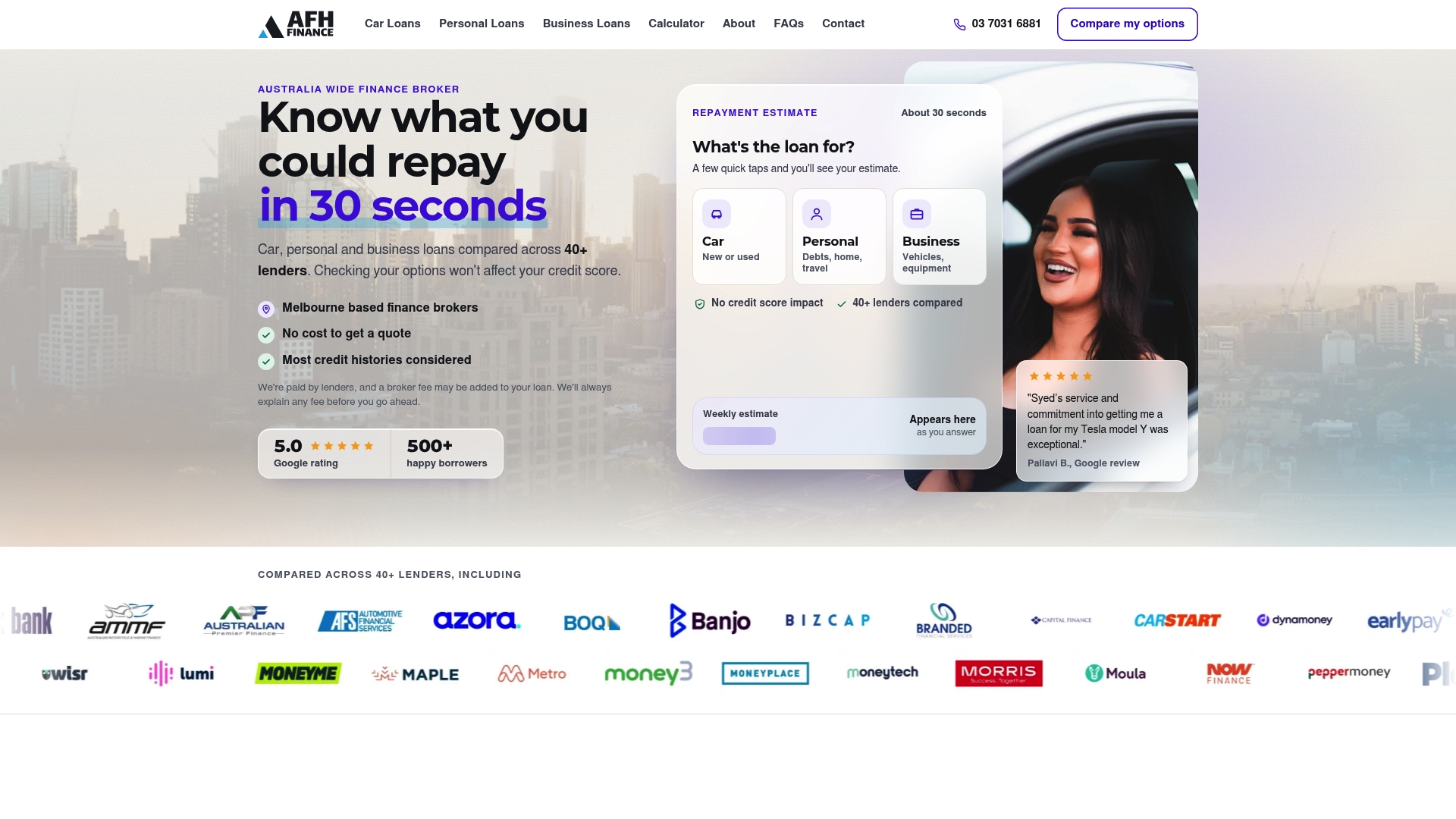
If you are weighing up a personal loan for planned dental work, you can start at AFH Finance and see your options. Checking your options is a soft enquiry with no credit score impact, and there is no cost to check your options. Whether a particular lender will consider a loan for dental treatment depends on that lender, which is something your broker can explain.
Tips for ABN holders and the self-employed
If you work for yourself, lenders may ask for different documents from an employee, such as tax returns, notices of assessment or business bank statements. Gather these before you start, because missing paperwork is a common cause of delays.
If you are buying equipment for a dental or medical practice rather than paying for treatment, that is a different product. Our business loans and equipment finance page covers vehicles, trucks and equipment for ABN holders.
Smart habits when you borrow for treatment
- Ask for a written treatment plan. Staged work should be priced stage by stage.
- Check what your health fund covers before you finance the rest. Look at annual limits and waiting periods on your policy.
- Do not borrow more than the treatment needs. The amount is your decision, ideally made after talking to a broker about your situation.
- Compare more than one option before lodging a formal application.
- Keep the paperwork. Save the quote, the contract and the fee disclosure.
- Know how to complain. Our complaints page explains how to raise a concern with us.
FAQ
Can I get a personal loan for dental work?
Yes, many people use a personal loan to pay for planned dental treatment. The lender decides whether to lend and sets the rate and terms based on your situation. A broker can compare lenders that may suit you.
Is dental finance the same as a dental loan?
Not always. Dental finance is a broad term that can mean a personal loan or a payment plan arranged through a clinic or a third party. A loan is a credit contract with a lender, while payment plans commonly run for 6, 12 or 24 months. Compare the total cost and terms of each.
Will checking my options affect my credit score?
Checking your options with AFH is a soft enquiry with no credit score impact. Formal applications are different, and Moneysmart notes that applying for many loans can hurt your score. That is why comparing before applying is worthwhile.
What does it cost to use a broker?
There is no cost to check your options. AFH is paid by lenders, and a broker fee may be added to the loan. We always explain any fee in writing before anything proceeds.
What should I check before signing?
Check the interest rate, comparison rate, all fees, whether the rate is fixed or variable, any early repayment fee and the full terms and conditions. Make sure the repayments fit your budget with room to spare.
Next steps
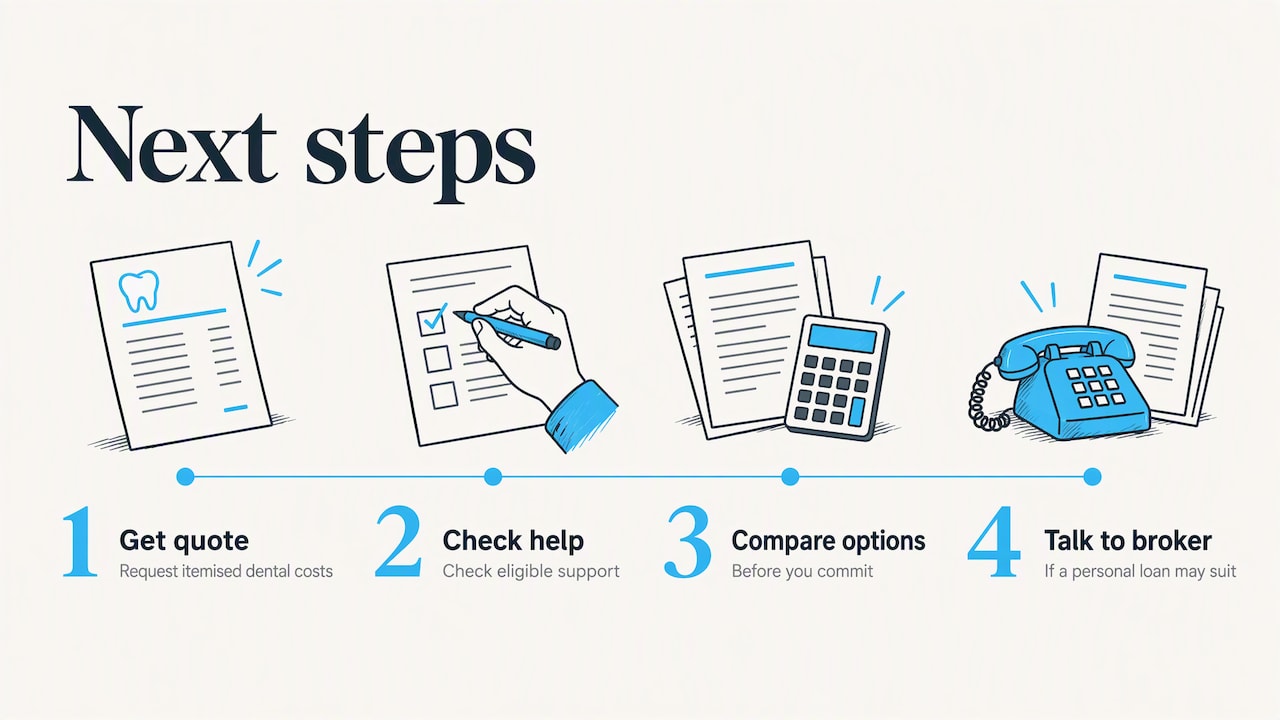
Get your dentist’s itemised quote, check what help you may be eligible for, then compare options before you commit. If a personal loan looks like it could suit you, our brokers can talk through lenders that may suit your situation. Start with our personal loans page.
AFH Finance Pty Ltd is Credit Representative 548852 of Access Lending Group Pty Ltd, ACL 531308. This article is general information only and is not personal advice.
Sources
- What’s covered by the Child Dental Benefits Schedule, Services Australia
- No Interest Loans, Moneysmart
- Personal loans, Moneysmart
- Dental Payment Plans in Australia
- ASIC Report 426
- ASIC Report 256
Recommended
See your options from our panel of 40+ lenders
Soft enquiry, no credit score impact. No cost to check your options.
Compare my optionsGeneral information only. This article doesn't consider your objectives, financial situation or needs, and isn't a credit offer. Lending criteria, fees and charges apply. We're paid by lenders, and a broker fee may be added to your loan. AFH Finance Pty Ltd, Credit Representative 548852 of Access Lending Group Pty Ltd, ACL 531308.