
A business loan broker compares finance options from a panel of lenders on your behalf, explains the terms and fees, and helps you lodge the application. They are not the lender, so the rate and the final decision always sit with the lender. At AFH Finance, a real broker looks at a panel of 40+ lenders, Australia wide, for business loans and equipment finance. There is no cost to check your options: AFH is paid by lenders, and a broker fee may be added to the loan, always explained in writing before anything proceeds.
See your options from our panel of 40+ lenders
Soft enquiry, no credit score impact. No cost to check your options.
Compare my optionsThis is general information only, not personal advice. Your own situation decides what suits you, so it is worth talking to a broker about it.
AFH Finance
afhfinance.com.au
Compare Business Finance Options
AFH Finance brokers compare business vehicle, truck and equipment finance options from a panel of 40+ lenders across Australia.
TL;DR
- A business loan broker sits between you and a panel of lenders. They compare options that may suit your business, help prepare the application and deal with the lender for you.
- Brokers are usually paid by the lender, and sometimes a broker fee is added to the loan. Ask for both in writing before you go ahead.
- A broker who provides credit assistance must hold an Australian Credit Licence, and the dispute resolution details should be easy to find.
- A broker can only compare the lenders on their own panel, so panel size and the types of finance covered are worth asking about.
- At AFH Finance, no cost to check your options. Soft enquiry, no credit score impact.
Table of Contents
- What a business loan broker does
- Broker, lender or marketplace: what is the difference?
- How a broker connects to lenders
- What a business loan broker can help you finance
- How brokers get paid
- The rules a broker works under
- What to check when choosing a business loan broker
- What a good broker conversation looks like
- When a broker is a sensible next step
- Where AFH Finance fits
- Our perspective
- FAQ
- Sources
What a business loan broker does
Think of a broker as the person who does the legwork between your business and the lenders. Every lender has its own paperwork, its own view of which industries and assets it likes, and its own way of assessing income. A broker knows how those differ and can point you towards lenders that may suit your situation, rather than leaving you to try each one in turn.
In practice the work usually covers:
- Understanding what you need. What you are buying or funding, whether it is a vehicle, a truck, equipment or working capital, and what the business can comfortably repay.
- Comparing options. Looking across a lender panel at the structures on offer, such as a secured loan against an asset or an unsecured loan, and the fees that come with each.
- Preparing the file. Collecting the documents lenders ask for and presenting the application clearly.
- Dealing with the lender. Answering the lender’s questions and keeping the application moving.
- Explaining the paperwork. Walking you through the terms, fees and repayments before you sign.
The Australian Banking Association’s small business finance guidance says an adviser can help improve a loan application and advise on suitable finance, and that a business adviser can help develop and refine a business plan so it translates for lenders. That is the practical value: a clearer application, put in front of the right kind of lender.
Broker, lender or marketplace: what is the difference?
These three get mixed up, and the difference matters when you read the fine print.
| Broker | Lender | Online marketplace | |
|---|---|---|---|
| Who provides the money | A lender on the panel | Itself | Lenders listed on the platform |
| What you deal with | A person who compares options and manages the application | The lender’s own products only | A website that lists products |
| Who sets the rate | The lender, based on your situation | The lender | The lender |
| How it is paid | Usually by the lender, sometimes a broker fee as well | Through the loan | Often by the lender or by listing fees |
A lender can only offer you its own products. A marketplace usually shows you a list and leaves the rest to you. A broker adds a person who talks through your circumstances, explains the options and handles the application. AFH Finance is a broker, never a lender: we work with lenders, and the lender sets the interest rate based on the borrower’s situation.
How a broker connects to lenders
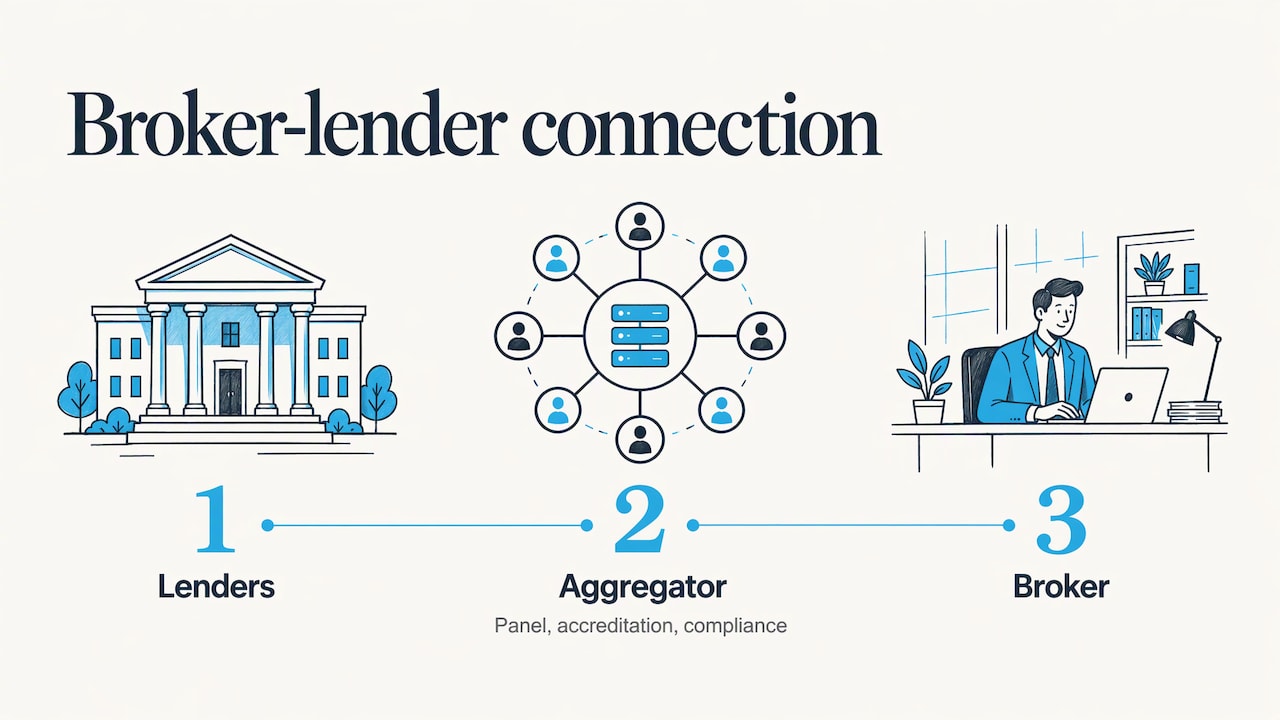
Most brokers do not sign up with 40 lenders one at a time. They usually work through an aggregator. The Mortgage and Finance Association of Australia describes aggregators as intermediaries between lenders and finance brokers. They typically hold an Australian Credit Licence and appoint credit representatives to operate under it. They also provide access to a lender panel, accreditation support and compliance support.
AFH Finance Pty Ltd works in that structure. We are Credit Representative 548852 of Access Lending Group Pty Ltd, ACL 531308. That is the licence behind the broker you speak to.
Panel size is the practical result. A larger panel gives the broker more lenders to consider, which matters because lenders differ in how they treat sole traders, newer businesses, particular vehicle types or equipment. A panel of 40+ lenders means a broker can look across many different lender appetites for your kind of purchase.
If you are weighing up buying a business rather than funding an existing one, some buyers also look at seller financed business listings as one funding route to understand before they talk through the whole structure with a broker.
What a business loan broker can help you finance
Business finance is a wide category. The ones our business customers ask about most are tied to something physical:
- Vehicles. Utes, vans, SUVs and cars used for work, new or used, from a dealer or a private sale.
- Trucks and heavy vehicles. Often financed against the vehicle itself.
- Equipment and machinery. Tools, plant and specialist gear. Our guides on how an equipment business loan works, business asset finance and machinery finance options and costs go into each.
- Caravans. If you are an ABN holder and a caravan is part of the picture, see our caravan loans page.
AFH Finance is built for employed Australians and ABN holders, so sole traders and businesses with an ABN are exactly who we speak to every day. If your need is personal rather than business, such as a renovation or travel, our personal loans page covers that, and our car loans page covers new, used and private sale cars.
How brokers get paid
This is the first thing most readers ask, and it is a fair question. Brokers are generally paid in one or both of two ways: a commission from the lender when a loan settles, and a broker fee that is added to the loan or charged to the borrower. Either way, you should see it written down before you commit.
Here is how we handle it. There is no cost to check your options. AFH is paid by lenders, and a broker fee may be added to the loan, always explained in writing before anything proceeds. You can see the figures, ask questions and decide with the paperwork in front of you.
The point to take from this is about transparency rather than any particular number. Whichever broker you speak to, ask:
- Are you paid by the lender, by me, or both?
- Is there a broker fee, and is it added to the loan amount?
- Will I get the fee in writing before I go ahead?
- Does the amount you are paid change depending on which lender I choose?
Fee amounts differ from one broker and one loan to the next, so the useful number is the one in your own written explanation.
The rules a broker works under
Broker regulation in Australia is built around licensing and disclosure. These are the points that matter to you as a borrower.
Licensing. Finance brokers who provide credit assistance must hold an Australian Credit Licence, or act as a credit representative of a licensee. You can check any broker on the ASIC registers using their licence or credit representative number. Ours are above.
Credit guide and disclosure. Under the consumer credit rules, a broker must provide a credit guide with specified information. The guide must also set out the broker’s internal dispute procedure and the details of the external dispute resolution scheme they belong to. The same source notes brokers must make reasonable inquiries and a preliminary assessment, and must not suggest a contract that is unsuitable. Many business loans sit outside the consumer credit rules because they are for business purposes, so the way a broker treats you in practice, including how clearly they explain remuneration and fees, is worth looking at either way.
Industry codes. Some brokers also belong to an industry body. For example, the FBAA’s Code of Conduct is enforced through a disciplinary scheme authorised by the ACCC. Membership is voluntary, members must comply, and breaches can form the basis of a complaint. A code adds a complaint pathway on top of the statutory minimum.
Complaints. If something goes wrong with our service, our complaints page sets out how to raise it.
What to check when choosing a business loan broker
Not every broker works the same way. These are the checks that tell you the most.
Licence and credit representative number
Ask for it, then look it up. A genuine broker gives it up front. If you are dealing with a credit representative, you should be able to see which licensee stands behind them.
Panel size and the kind of finance covered
A broker generally can only compare the lenders on their own panel. The Law Handbook points out that a panel of lenders who pay the broker commission may not include every available loan. So ask how many lenders are on the panel and whether it covers what you are financing. Ours is 40+ lenders, covering car, personal, business and caravan finance.
How the broker is paid
Use the four questions in the previous section. A broker who answers plainly and puts it in writing is easy to compare with one who stays vague.
Who you will actually speak to
With AFH Finance, you start online with a short set of questions and see indicative repayments. Then a real broker calls you to confirm the options that may suit your situation. You deal with a person, not a call centre.
What the enquiry does to your credit file
Checking your options with us is a soft enquiry, no credit score impact. Ask any broker what type of enquiry they make and when, so you know what is recorded and when.
Reviews and track record
Look at independent reviews and how many customers a broker has worked with. AFH Finance is rated 5.0 on Google from 63 reviews, with 750+ borrowers helped.
What a good broker conversation looks like
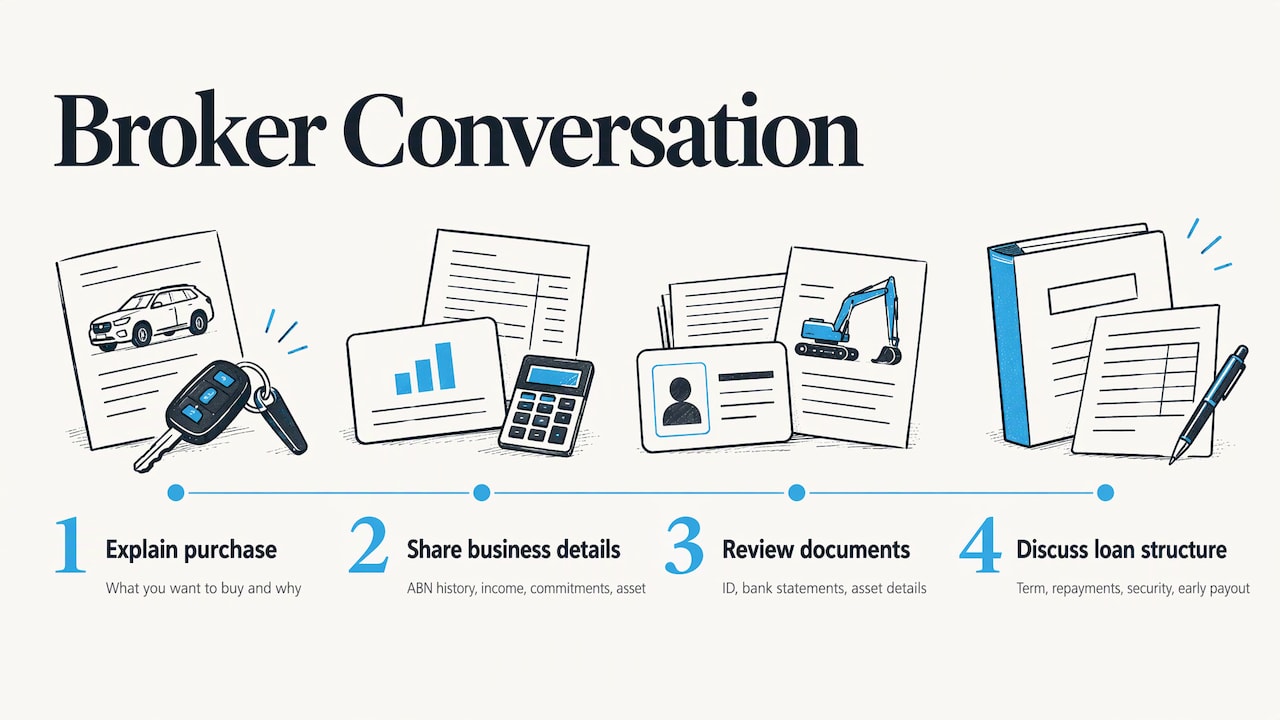
A strong first conversation has a rhythm. You explain what you want to buy and why. The broker asks about your ABN and how long you have held it, your income, your existing commitments and the asset itself. They explain what documents lenders usually ask for, which commonly include identification, bank statements and details of the vehicle or equipment, though the list varies by lender and by loan.
They should also be willing to talk about the shape of the loan rather than only the headline. Term, repayment structure, security, and what happens if you want to pay it out early can all change the total cost over time. We cannot say how much you should borrow: that depends on your business, your cash flow and your plans, so it is a conversation to have with a broker about your own situation.
Documents that tend to come up
Having these ready makes the conversation more useful:
- Photo identification for the applicant
- Recent bank statements
- Details of the asset, such as a dealer invoice or a private sale contract
- ABN details and, for some applications, income evidence such as tax returns
Lenders set their own requirements, so your broker will confirm what applies to the lender and the loan in question.
When a broker is a sensible next step
People tend to talk to a broker when:
- They are a sole trader or ABN holder and are unsure how lenders will view their income.
- They are buying from a private seller and want the process handled properly.
- They want to see more than one lender’s view before they commit.
- They are financing a truck, equipment or machinery and are not sure of the finance structure.
- They would rather deal with one person than fill in several applications.
Employed full time or part time Australians also use brokers for car and personal finance, in the same way.
Where AFH Finance fits
If you are an ABN holder or a business looking at vehicle, truck or equipment finance, AFH Finance’s business loans and equipment finance service is built for that. You answer a short set of questions online and see indicative repayments. A real broker then calls you to confirm the options that may suit your situation, from a panel of 40+ lenders.
No cost to check your options. Soft enquiry, no credit score impact. AFH is paid by lenders, and a broker fee may be added to the loan, always explained in writing before anything proceeds.
You can also see indicative repayments for car and personal loans with our repayment calculator. The rate on any loan is set by the lender based on the borrower’s situation, so the calculator is a starting point for the conversation with a broker.
Our perspective
Most business owners we speak to are not short of ambition. They are short of time. Finance sits on the list behind the job in front of them, so the application gets done in a rush, with whichever lender is nearest.
We built AFH Finance around a different habit. A real broker, not a call centre, looks across a panel of 40+ lenders, Australia wide, and talks through the options that may suit your situation. We work with employed Australians and ABN holders every day, so we are comfortable with sole traders, with private sales and with the paperwork that comes with them.
We think a broker should be clear about how they are paid. We are paid by lenders, and a broker fee may be added to the loan. We explain it in writing before anything proceeds, because you should decide with all the information in front of you.
And we think checking your options should be low pressure. It is no cost to check your options, and it is a soft enquiry, no credit score impact. Then you decide.
AFH Finance
FAQ
Do I need a business loan broker, or can I go straight to a lender?
You can approach a lender directly. A lender can only talk about its own products, though. A broker compares options from a panel of lenders and handles the application with you. Which suits you depends on your situation, so it is worth talking to a broker about it.
Is AFH Finance a lender?
No. AFH Finance is a broker. We compare options from a panel of 40+ lenders, and the lender sets the rate based on the borrower’s situation. We are Credit Representative 548852 of Access Lending Group Pty Ltd, ACL 531308.
What does it cost to use AFH Finance?
No cost to check your options. AFH is paid by lenders, and a broker fee may be added to the loan. We always explain it in writing before anything proceeds.
Will checking my options affect my credit score?
Soft enquiry, no credit score impact. Any application you later decide to lodge with a lender is a separate step, and your broker will explain what it involves before you go ahead.
Can sole traders and ABN holders use a business loan broker?
Yes. AFH Finance is built for employed Australians and ABN holders, covering business vehicles, trucks and equipment. A broker can talk through how lenders may view your situation.
Sources
- Using an adviser, Australian Banking Association small business finance
- Choose an aggregator, MFAA
- Finance brokers, The Law Handbook
- FBAA determination, ACCC public register
Recommended
- Business Loans & Equipment Finance Australia
- Equipment Business Loan: How It Works in Australia
- Business Asset Finance in Australia: How It Works
See your options from our panel of 40+ lenders
Soft enquiry, no credit score impact. No cost to check your options.
Compare my optionsGeneral information only. This article doesn't consider your objectives, financial situation or needs, and isn't a credit offer. Lending criteria, fees and charges apply. We're paid by lenders, and a broker fee may be added to your loan. AFH Finance Pty Ltd, Credit Representative 548852 of Access Lending Group Pty Ltd, ACL 531308.